
Supreme Court Dismisses Delhi Waqf Board's Claim Over Gurudwara Dispute
In a significant ruling, the Supreme Court of India has dismissed the Delhi Waqf Board's claim that a certain premises was being used as a Gurudwara. The court's decision came after the board appealed against a previous ruling by the Delhi High Court. Justice Sanjay Karol and Justice Satish Chandra Sharma emphasized that the board should have withdrawn its claim, noting that a religious structure was already in place. The case revolves around the historical claims of the Waqf Board and the ownership disputes regarding the property, which has been a point of contention for decades. This ruling highlights the complexities surrounding religious property claims in India.
| Jun 4, 2025, 17:04 IST
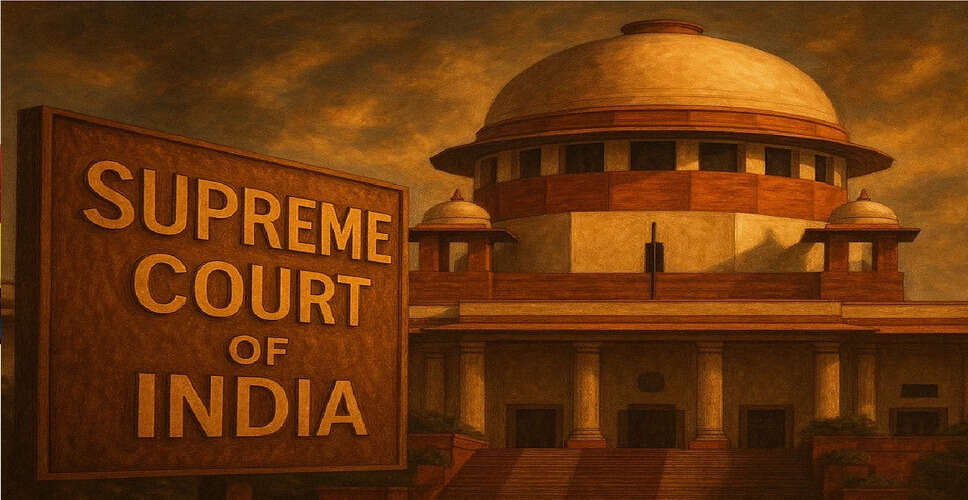
Supreme Court Ruling on Waqf Board's Claim
The Supreme Court of India rejected the Delhi Waqf Board's assertion on Wednesday, which claimed that a certain premises was being utilized as a Gurudwara. A bench comprising Justice Sanjay Karol and Justice Satish Chandra Sharma dismissed the board's appeal against a 2010 decision by the Delhi High Court that had previously turned down its petition. Justice Sharma remarked that the board should have withdrawn its claim on its own.
However, senior advocate Sanjay Ghosh, representing the board, argued that lower courts had acknowledged the presence of a mosque at the site, but now it has transformed into a Gurudwara.
Court's Decision on the Appeal
In its ruling, the court stated that there was no basis for the appeal. Once a site is established as a Gurudwara, it should be allowed to remain as such. The court noted that a religious structure was already functioning there, and the board should have relinquished its claim. According to the Waqf Board, the disputed mosque in Shahdara was known as Masjid Takiya Babbar Shah, which the board claims has existed since time immemorial and was dedicated for religious purposes.
On the other hand, the respondent contended that the property was not Waqf property, as the owner, Mohammad Ehsan, sold it in 1953. The Delhi High Court had ruled in favor of the respondent.
High Court's Findings
The High Court noted that the respondent had occupied the property since 1947-48. Although the respondent could not provide any documentation proving ownership of the property, this did not benefit the petitioner, who needed to establish their case and prove their claim to obtain an order for possession.