
Supreme Court Denies Laloo Prasad Yadav's Plea in Job-for-Land Scam Case
In a significant ruling, the Supreme Court has rejected Laloo Prasad Yadav's request to quash the CBI's FIR in the alleged job-for-land scam. The court's decision allows the case to continue, despite Yadav's claims of legal impropriety regarding the investigation process. The case, linked to appointments made during his tenure as Railway Minister, raises serious questions about corruption and accountability. Yadav has been granted exemption from personal appearance in lower court proceedings, but the legal battle is far from over. This ruling marks a crucial moment in the ongoing scrutiny of political figures and their dealings.
| Apr 13, 2026, 15:27 IST
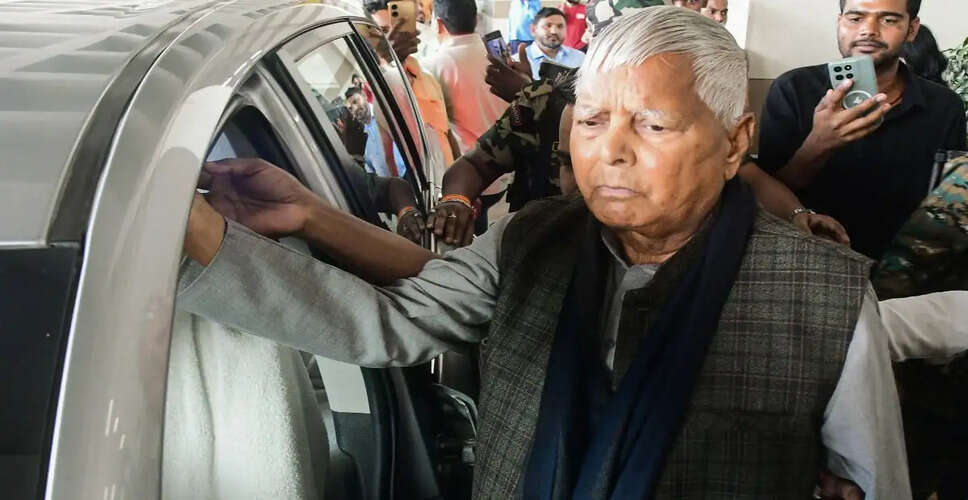

Supreme Court's Ruling on Job-for-Land Scam
On Monday, the Supreme Court rejected the plea of RJD leader Laloo Prasad Yadav to dismiss the CBI's FIR and charge sheet in the alleged 'job-for-land' scam, delivering a legal setback to the former Chief Minister of Bihar. The apex court dismissed Yadav's petition to quash the FIR and related proceedings against him and several family members. However, the court granted him exemption from appearing personally in the lower court during the proceedings.
The bench, comprising Justices M M Sundresh and N Kotiswar Singh, allowed Yadav (77) to raise the issue of the applicability of Section 17A of the Prevention of Corruption Act in this case. Earlier, on March 24, the Delhi High Court had dealt a significant blow to the RJD chief by refusing to quash the FIR filed by the Central Bureau of Investigation (CBI) related to the 'job-for-land' case involving him and his family.
The court dismissed Yadav's argument that the agency's actions were not legally sustainable, as prior approval under Section 17A of the Prevention of Corruption Act was not obtained. Officials indicated that this alleged job-for-land case pertains to the 'Group D' appointments made in the West Central Railway zone in Jabalpur, Madhya Pradesh, during Yadav's tenure as Railway Minister from 2004 to 2009.
According to officials, these appointments were allegedly made in exchange for land that was gifted or transferred in the names of Yadav's family or associates. Yadav contended that the investigation, FIR, and subsequent charge sheet were not legally sustainable due to the lack of prior approval under the anti-corruption law.