
Supreme Court Deliberates on Ayodhya Land Acquisition Dispute: What’s at Stake?
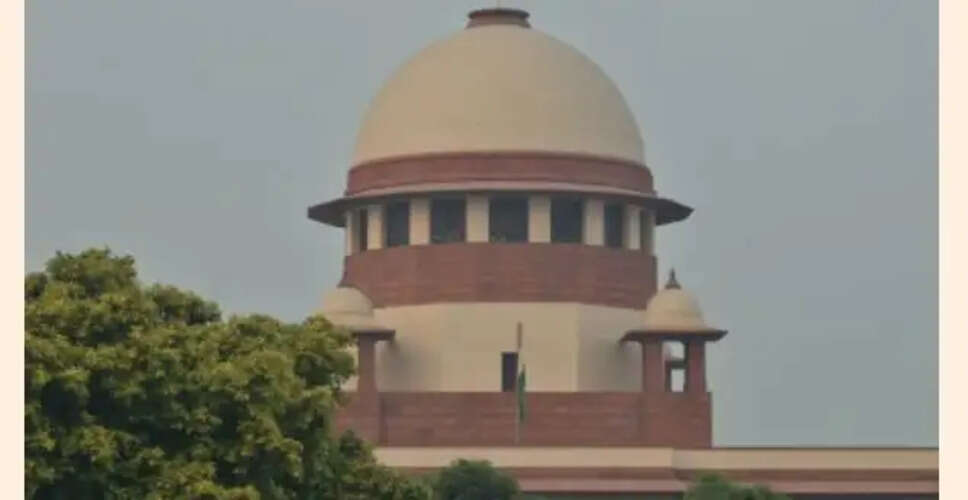

Supreme Court's Verdict Reserved on Ayodhya Land Acquisition Case
New Delhi: On Monday, the Supreme Court reserved its decision regarding a petition filed by the Shri Saryu Nagar Vikas Samiti, which is contesting the land acquisition for a housing project in Ayodhya.
The Allahabad High Court's Lucknow bench had previously instructed the Uttar Pradesh Awas Evam Vikas Parishad on August 6 to assess compensation, rehabilitation, and resettlement benefits in accordance with the Uttar Pradesh Awas Evam Vikas Parishad Adhiniyam, 1965.
The court emphasized that the authority must adhere to the legal principles established in its ruling, including those outlined in the Right to Fair Compensation and Transparency in Land Acquisition, Rehabilitation and Resettlement Act, 2013.
A bench led by Chief Justice of India Surya Kant, along with Justices Joymalya Bagchi and V Mohana, heard arguments from senior advocate Gopal Sankaranarayanan, representing the petitioner, and Additional Solicitor General Aishwarya Bhati, who defended the state government.
Sankaranarayanan argued that the authorities should not limit the benefits for affected landowners to just monetary compensation and rehabilitation, neglecting other protections under the 2013 Act, such as social impact assessments (SIA) and the use of previously acquired land.
The bench acknowledged the importance of SIA but cautioned against it becoming a burden for the state government.
They also stressed the necessity of considering public interest in ongoing development projects.
During the proceedings, Sankaranarayanan claimed that the High Court's ruling had unduly restricted the Samiti's rights to compensation under the 2013 Act, which offers a more comprehensive framework for landowner protections.
He pointed out that the acquisition in question began after the enactment of the new law, yet its provisions had not been fully implemented.
The Chief Justice questioned the assertion that the High Court had limited the Samiti's rights, noting that the judgment allowed for benefits under the 2013 Act to be applied to the acquisition.
However, the senior lawyer insisted that the issue extended beyond compensation and rehabilitation, encompassing safeguards relevant to the initial decision on land acquisition.
He referenced Section 8(1)(d) of the 2013 Act, stating that the government must ensure that previously acquired land in the area had been utilized before proceeding with further acquisitions.
Sankaranarayanan informed the bench that three housing schemes involved the acquisition of 1,407 acres, of which only 70 acres had been utilized, leaving approximately 1,300 acres from the first two schemes unutilized.
He argued that the authorities had not provided sufficient information regarding the use of this land.
The challenge was specifically focused on the third scheme.
He urged the bench to halt the scheme until the SIA process, which had been initiated but later abandoned, was completed.
In response, Additional Solicitor General Bhati asserted that the authorities were providing all benefits under the 2013 Act, including enhanced compensation and other entitlements.
She explained that the acquisition framework was treated as a self-contained code, extending benefits under the central legislation to affected landowners.
Bhati argued that since these benefits were available, the dispute had become largely theoretical and should not impede the development plan.
She also mentioned that the project was part of a larger policy decision and development plan for Ayodhya, which included multiple components.
Bhati offered to present the complete development plan to the court, emphasizing that progress in a significant pilgrimage destination should not be stalled as requested by the petitioners.
Regarding future acquisitions, she stated that the authorities were open to improving the process and would continue to make necessary adjustments.
After hearing both sides, the bench reserved its verdict.
The respondents in this case include the Uttar Pradesh Avas Evam Vikas Parishad, the Housing Commissioner, the Executive Engineer, the District Magistrate, and the Special Land Acquisition Officer.
Previously, the high court had directed the Uttar Pradesh Awas Evam Vikas Parishad to determine compensation, rehabilitation, and resettlement benefits in compulsory land acquisition proceedings, following the legal principles established in its judgment, while disposing of a series of petitions challenging land acquisition for three housing and development schemes in Ayodhya.