
Supreme Court Declares Walking on Footpaths a Fundamental Right: What This Means for Citizens
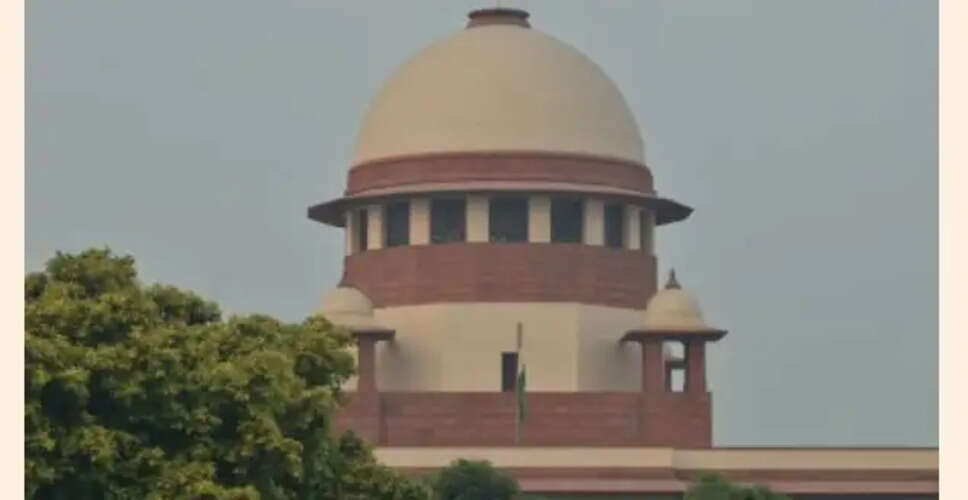

Supreme Court's Landmark Ruling on Pedestrian Rights
New Delhi: The Supreme Court has made a pivotal ruling affirming that the right to walk on designated footpaths is a fundamental right.
In a groundbreaking decision, the court emphasized that this right takes precedence over the movement of motor vehicles on marked paths, as it is part of the right to movement protected under Article 19 (1) (d) and other fundamental rights, including Article 21, which guarantees the right to life and liberty.
A bench comprising Justices PS Narasimha and AS Chandurkar stated that the fundamental right of citizens to walk on designated footpaths is paramount and should take precedence over vehicular traffic.
This ruling emerged from a tragic case involving a father who lost his five-year-old son in a motor accident while on their way to school.
The court declared, "The right to walk is a fundamental right under Part III of the Constitution. It is integral to the right to movement guaranteed under Article 19(1)(d), along with Articles 19(1)(a), 19(1)(b), 19(1)(c), and Article 21 of the Constitution of India. The fundamental right to walk encompasses the right to use demarcated footpaths. These rights are primary and shall take precedence over motor vehicle movement."
The bench also noted that the right to walk on designated footpaths comes with a corresponding duty, stating, "If a road exists, there is a duty to ensure that there are well-maintained and clearly marked footpaths for pedestrians."
It highlighted that urban development authorities, municipal corporations, municipalities, and even local panchayats are responsible for the demarcation, construction, maintenance, and protection of footpaths and pedestrian infrastructure, as walking is essential to life.
The court further asserted that any infringement of the right to walk on designated footpaths allows citizens to seek constitutional and legal remedies against those responsible for maintaining these paths, independent of the provisions under the Motor Vehicles Act, 1988.
The Supreme Court instructed the registry to forward the judgment to relevant central ministries and the law commission to establish the necessary legal framework.
The court remarked that humans have been walking long before vehicles were invented, emphasizing that the fundamental right to movement under Article 19(1)(d) is essentially the right to walk, which should be prioritized over vehicular movement. This right must ensure access to safe and well-defined footpaths.
The bench reiterated, "The citizen's fundamental right to walk on a demarcated footpath is primary and shall take precedence over motor vehicle movement," noting that accidents like the one in this case will persist until citizens redefine their rights concerning road access and acknowledge their corresponding responsibilities.
The court expressed concern that society often overlooks the importance of recognizing and securing the "right to walk."
It pointed out that historically, motorized vehicles were a luxury for the affluent, but as economies evolved and more affordable vehicles became available, they began to dominate the roads, often disregarding pedestrians, who are frequently treated as obstacles.
The bench emphasized that this trend must change, declaring the fundamental right to walk on designated footpaths alongside motorized roads.
Additionally, the court criticized the Motor Vehicles Act, 1988, for not recognizing the fundamental right to walk, stating that it has often hindered and undermined the rights of pedestrians.
The absence of safe and accessible footpaths, or their subordination to motorized transport, has been a long-standing societal issue, the court noted, asserting that the fundamental right to walk simply requires a comfortable space for pedestrians.
The court highlighted that the Motor Vehicles Act primarily focuses on vehicles, with pedestrian interests being secondary, and called for a clear affirmation of the fundamental right to walk on designated footpaths, along with the duty to provide and maintain them.
The Supreme Court mandated that if a road exists, there must be a corresponding obligation to ensure that a footpath is marked and maintained for pedestrians. This is an enforceable duty, and the right to walk on designated footpaths will take precedence over the privileges of motorized vehicles.
In a related decision, the court increased the compensation for a motor accident claim to ₹11,44,628, which is to be paid to the father of the deceased child within two months, overturning a previous high court ruling that had reduced the amount.
The court also directed the registry to register the case under the title "Re: Fundamental Right to Walk and Footpath" and included the Centre through the Ministries of Housing and Urban Affairs, Rural Development, and Road Transport and Highways as parties, seeking assistance from ASG KM Nataraj in the matter.