
Supreme Court Clarifies Distinction Between Genuine Protesters and Violent Individuals in NEET Paper Leak Case
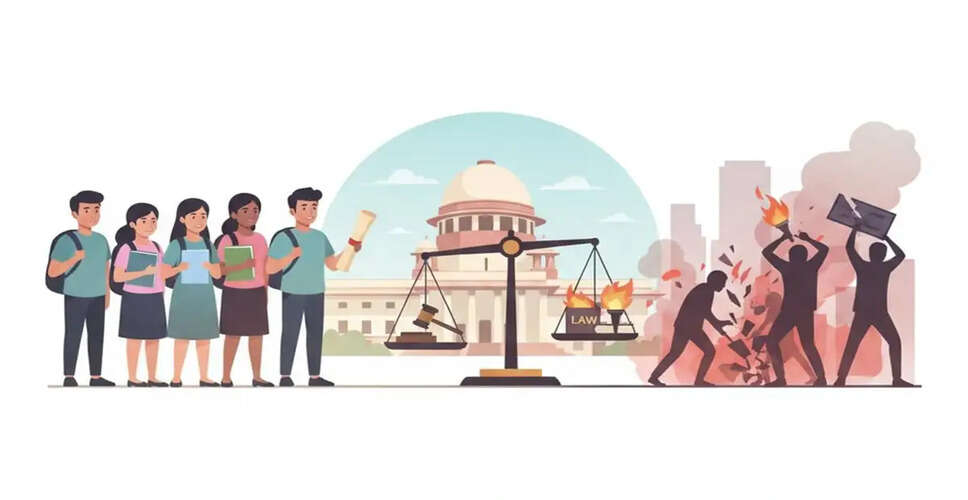

Supreme Court's Interim Order on NEET Protests
New Delhi, July 28 - The Bharatiya Janata Party (BJP) stated on Tuesday that the interim ruling by the Supreme Court regarding petitions related to the alleged NEET question paper leak has clearly differentiated between genuine student protesters and those involved in violence. The party emphasized that while dissent is acceptable, rioting is not.
This statement came after the Supreme Court instructed authorities to continue investigating registered complaints but refrain from punitive actions against protesters. Additionally, it ordered the release of protesters under 18 years of age with no criminal records. The court also directed the preservation of electronic and digital evidence linked to the recent nationwide protests concerning the NEET paper leak.
During the hearing on petitions related to alleged police excesses, the bench led by Chief Justice (CJI) D.Y. Chandrachud remarked on the necessity for a fair and independent investigation into the allegations. This investigation should also address the concerns of families of over 200 injured police officers.
BJP national spokesperson Shehzad Poonawalla noted that the Supreme Court has approached the matter with maturity and sensitivity. He expressed on the social media platform 'X' that the court's handling of the situation deserves appreciation.
Poonawalla asserted that there is a clear distinction between students and those engaging in arson or riots. He stated, 'Students deserve protection, while those committing arson do not. The court has made this clear.'
He reiterated, 'Dissent is acceptable, but rioting is not. Students are justified, while those causing destruction are not. Protests are valid, but incitement is not.'
The BJP spokesperson claimed that the government is already committed to ensuring that no cases are pursued against genuine student protesters.
However, he added that cases against those involved in arson will continue. Individuals accused of assault, vandalism, or other criminal acts cannot expect universal 'full protection.'
Referencing the Chief Justice's comments, Poonawalla highlighted that the court acknowledged the need for a fair and independent investigation, which should also address the concerns of families of the injured police officers.
The bench, comprising Justices Chandrachud, Joymalya Bagchi, and V. Mohan, directed all states where protests occurred to secure CCTV footage, drone recordings, body camera footage, wireless communication records, PCR logs, and other digital evidence. The Supreme Court also ordered that any digital data collected related to the protesters be preserved but not made public.