
Supreme Court Clarifies Definition of 'Industry' in Landmark Ruling

Supreme Court's Recent Decision
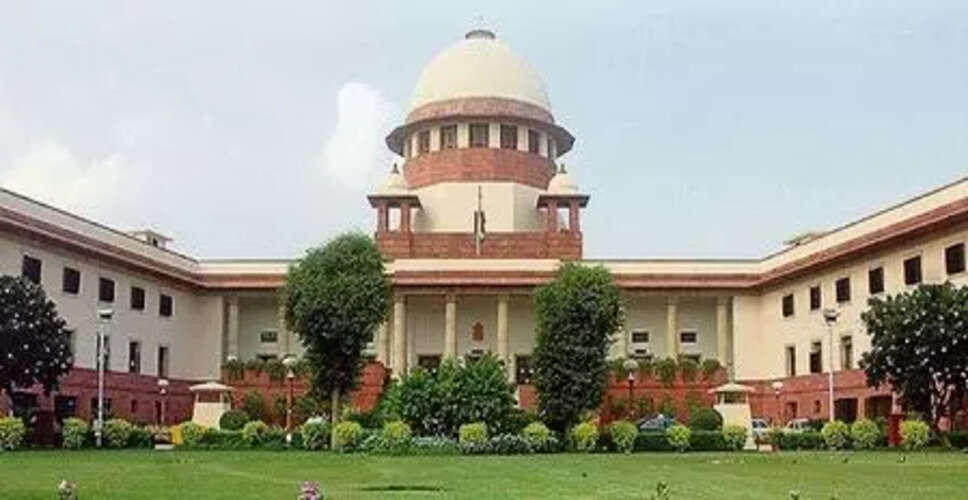
A file image of the Supreme Court (Photo: @IANS)
New Delhi, Aug 20: On Thursday, the Supreme Court delivered a significant ruling with a 6:3 majority, stating that the broad definition of 'industry' established in its pivotal 1978 ruling cannot be applied to interpret the Industrial Relations Code of 2020.
A nine-judge Constitution bench, led by Chief Justice Surya Kant, affirmed that the request for reconsideration of the 1978 ruling regarding the term 'industry' was appropriately made.
The bench reviewed the legal framework set by the Supreme Court in the 1978 Bangalore Water Supply and Sewerage Board case, which notably expanded the definition of 'industry' under the Industrial Disputes Act of 1947.
What was the court's decision?
Chief Justice Surya Kant, along with Justices Satish Chandra Sharma, Alok Aradhe, and Vipul M Pancholi, clarified that the 'triple test' established in the 1978 ruling remains applicable.
However, this test will only pertain to ongoing labor-related cases under the now-repealed Industrial Disputes Act of 1947.
The majority opinion also specified that the principles from 1978 cannot be directly transferred to the Industrial Relations Code of 2020.
Cases under the new legislation will need to be evaluated based on their specific facts and circumstances.
"The majority has confirmed that the reference is valid, and we have made it clear that the majority will apply prospectively, with pending matters (under the ID Act of 1947) being adjudicated according to the triple test definition from the Bangalore Water Supply (1978 ruling)," stated the Chief Justice.
He further noted that the principles from the 1978 decision "should not be viewed as a blanket guideline for interpreting the 2020 Act, which will be assessed independently." Detailed judgments are still awaited.
What constitutes the 'triple test'?
The triple test, formulated by Justice V R Krishna Iyer in the 1978 ruling, essentially states that a systematic activity involving collaboration between employers and employees for the production or distribution of goods and services can be classified as an 'industry'.
This broad interpretation allowed a wide array of workplaces and institutions, including hospitals, educational establishments, clubs, and government welfare departments, to fall under the protective umbrella of the Industrial Disputes Act.
As a result, statutory labor protections were extended to millions of workers across various sectors.
What was the stance of the minority judges?
Justices P S Narasimha and Joymalya Bagchi provided separate opinions but largely concurred with the majority, particularly regarding the validity of the reference to the nine-judge bench.
Conversely, Justices B V Nagarathna, Dipankar Datta, and Ujjal Bhuyan dissented, especially concerning the maintainability of the reference itself.
Justice Nagarathna asserted that the 1978 ruling was correctly decided and did not necessitate reconsideration.
Nonetheless, all nine judges acknowledged that the Industrial Disputes Act of 1947 has been repealed and replaced by a new law, rendering the issue somewhat academic.
Why is this ruling significant?
This ruling delineates a clear distinction between ongoing disputes under the previous labor law and those arising under the new Industrial Relations Code.
For cases pending under the 1947 Act, the 1978 'triple test' remains in effect. However, workers and employers cannot assume that the same broad definition will apply to determine if an activity qualifies as an 'industry' under the 2020 Code.
The Constitution bench was established to explore, among other matters, whether the 1978 test remains legally sound and how subsequent legislative changes, including the Industrial Disputes (Amendment) Act of 1982 and the Industrial Relations Code of 2020, influence the interpretation of 'industry'.
The court also examined whether social welfare activities, schemes, and other enterprises operated by government departments or their agencies could be classified as 'industrial activities' under Section 2(j) of the 1947 Act.
The ruling from the nine-judge bench follows the February 21, 1978 decision of a seven-judge bench, which broadened the definition of 'industry' in the Bangalore Water Supply and Sewerage Board case.