
Supreme Court Addresses Recent Violence in West Bengal Amid Judicial Criticism
Supreme Court's Stance on Judicial Criticism
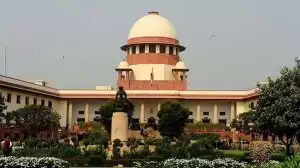
In a recent session, Justice BR Gavai of the Supreme Court remarked on the ongoing criticism of the judiciary, stating, "We are often accused of overstepping our boundaries regarding parliamentary and executive functions." This comment was made while the court was reviewing a new petition related to the violence that erupted in West Bengal during protests against the Waqf law.
The petition was brought forth by Advocate Vishnu Shankar Jain, who previously filed a Public Interest Litigation (PIL) in 2021, advocating for President's Rule in West Bengal due to violence following the Assembly elections. Jain requested that the court hear this new plea on the matter.
He emphasized the urgency of addressing the recent violence, stating that the deployment of paramilitary forces and immediate action were necessary. Jain referenced Article 355 of the Constitution, which mandates the Union's responsibility to protect states from internal disturbances and external threats, suggesting that the Supreme Court could request a report on the situation in West Bengal.
The Supreme Court had previously acknowledged Jain's 2021 petition, which sought the deployment of armed forces in the state, and had issued notices to the Centre, the West Bengal government, and the Election Commission regarding the plea.
Recently, two additional petitions were submitted to the Supreme Court, calling for a court-monitored investigation into the violence linked to the newly passed Waqf (Amendment) Act.
On April 14, fresh violence related to the Waqf law occurred in the Bhangar area of South 24 Parganas district, while police reported that the law and order situation in Murshidabad, another area affected by riots, was largely stable.
The communal unrest in Murshidabad on April 11 and 12 resulted in at least three fatalities and left hundreds displaced during protests against the Waqf (Amendment) Act.
Vice President Jagdeep Dhankhar and BJP MP Nishikant Dubey recently criticized the judiciary, with Dhankhar questioning the court's authority to impose timelines on presidential decisions and suggesting that the Supreme Court should not act as a "super Parliament." Dubey echoed these sentiments, suggesting that if the Supreme Court were to legislate, then Parliament and assemblies should be dissolved, and he attributed the rise of "religious wars" in India to Chief Justice of India Sanjiv Khanna.