
Supreme Court Addresses Illegal Detention During CJP Protest in Delhi

Supreme Court's Intervention in Delhi Protest
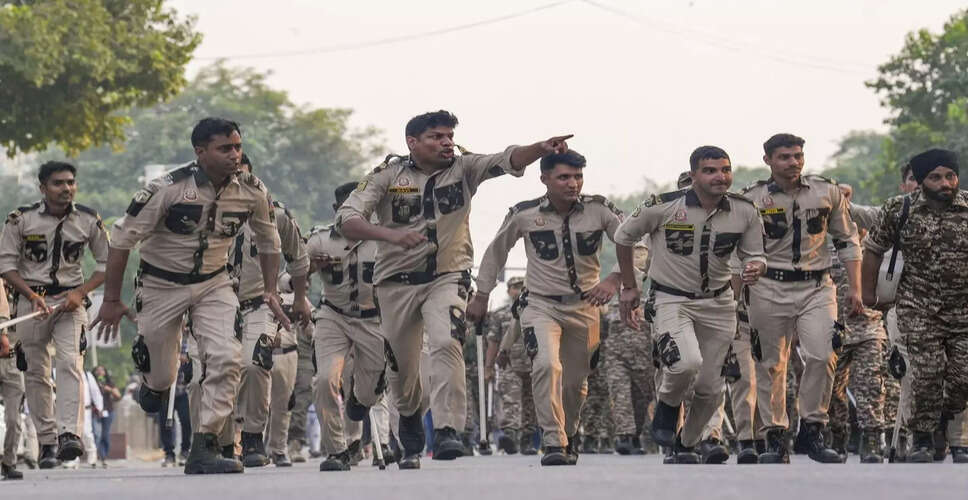
Security personnel run towards demonstrators to disperse them during the CJP protest at New Delhi's Connaught Place, on Saturday. (Photo:PTI)
New Delhi, Oct 11: On Sunday, the Supreme Court mandated that individuals peacefully assembling should not face unlawful detention and issued a notice to the central government regarding a plea for contempt proceedings over alleged breaches of its directive to maintain metro and train operations in Delhi amid the CJP protest.
During an urgent session, a bench comprising Justices Joymalya Bagchi and V Mohana instructed Solicitor General Tushar Mehta to ensure that the Delhi Metro operates according to its regular timetable and that internet services remain uninterrupted, provided law and order is maintained.
The bench convened for this urgent hearing due to claims of violations of its October 9, 2026, order and the unlawful detention of numerous individuals in Delhi on October 10.
"Senior counsels reported a blatant disregard for the court's directives—metro services were halted, New Delhi and Nizamuddin railway stations were closed, no traffic advisories were issued, and many individuals faced undue harassment and illegal detention beyond the areas covered by the prohibitory order under Section 163 of the Bharatiya Nagarik Suraksha Sanhita (BNSS), 2023," the bench remarked.
The Supreme Court also instructed Mehta to ensure that lawyers, journalists, and others are not obstructed in fulfilling their professional responsibilities.
During the proceedings, Mehta stated that entry and exit were restricted at only 45 out of 303 metro stations on October 10.
As the hearing began, the apex court expressed its intention to hear all lawyers involved in a plea seeking contempt proceedings against authorities for the alleged flagrant violation of the court's orders.
The court was also considering a habeas corpus petition filed by senior advocate Menaka Guruswamy concerning the detention of political figures.
The contempt petition, submitted by advocate Shailendra Mani Tripathi, named Union Home Secretary Govind Mohan, Delhi Police Commissioner Anurag Kumar, and Delhi Metro Rail Corporation chairperson D Thara as respondents.
This petition referenced the Supreme Court's October 9 order, which was issued while addressing a separate plea regarding the closure of 57 metro stations and the cancellation of trains to Delhi due to the protest.
The protest was organized by the CJP and various student groups against Chief Election Commissioner Gyanesh Kumar, citing alleged irregularities in the Election Commission's operations.
The government prevented a planned mass gathering at Jantar Mantar on Saturday following an extensive security crackdown and the detention of over 7,000 protesters, including CJP leader Abhijit Dipke, several opposition figures, and YouTuber Dhruv Rathee.