
Supreme Court Addresses Allegations Against West Bengal CM Mamata Banerjee Over ED Searches
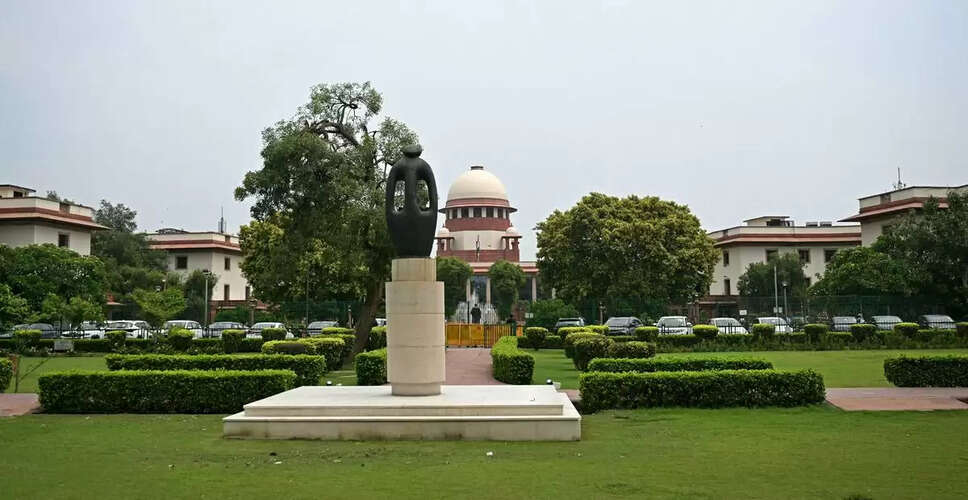
Supreme Court's Remarks on ED Searches
On Wednesday, the Supreme Court expressed concerns regarding West Bengal Chief Minister Mamata Banerjee's alleged interference with the Enforcement Directorate's (ED) searches at the political consultancy I-PAC, labeling the situation as "not ideal," according to reports.
The bench, comprising Justices Prashant Kumar Mishra and NV Anjaria, characterized the incident as an "unusual occurrence," emphasizing that a central agency should not be left without recourse when its operations are hindered.
The court questioned whether there could be no legal means to prevent such incidents from recurring.
This discussion arose during the hearing of a petition filed by the ED against Banerjee and several West Bengal Police officials, who were accused of obstructing searches conducted on January 8.
On that date, the ED executed searches at I-PAC's office in Kolkata's Salt Lake area, as well as at the residence of its head, Pratik Jain, and a trader's office in the Posta area, as part of an investigation into alleged money laundering.
I-PAC has been instrumental in managing the Trinamool Congress' election campaigns, including the 2021 Assembly elections.
During the search, Banerjee arrived at Jain's residence around noon and remained there for approximately 20 to 25 minutes. She later emerged with a file, alleging that ED officials were "removing" party documents ahead of the upcoming Assembly elections.
The elections in West Bengal are scheduled to take place in two phases on April 23 and April 29, with results expected on May 4.
Following the raids, both the Trinamool Congress and I-PAC approached the Calcutta High Court to challenge the legality of the searches. The ED also filed a petition in the High Court, claiming "illegal interference" in its operations.
The ED's petition to the Supreme Court was submitted under Article 32 of the Constitution, which allows individuals to seek enforcement of their fundamental rights from the highest court.
During the hearing, advocates representing the state government and Banerjee contended that the ED lacked the authority to file a writ petition under Article 32.
One advocate argued that the ED is not a juristic entity and therefore does not possess fundamental rights, as reported.
The bench, however, raised concerns about the implications of allowing a chief minister to obstruct a central agency's work, stating, "It is not a very happy situation."
The court also highlighted the necessity of avoiding a legal vacuum, asserting that there should always be a mechanism to resolve such matters.
During the proceedings, Sibal argued that the right to investigate is not a fundamental right, and the ED cannot invoke Article 32 without a violation of fundamental rights.
In contrast, Solicitor General Tushar Mehta, representing the ED, emphasized that the issue transcends technicalities and pertains to whether a constitutional authority can impede a central agency's statutory duties.
The bench indicated that it would consider both the question of maintainability and the merits of the case together, rejecting the state government's request to address maintainability as a preliminary matter.
The case is set for further hearings next week.
Background of the Case
In February, the ED informed the Supreme Court that it was challenging to ascertain whether the materials taken by Banerjee during the alleged obstruction belonged solely to the Trinamool Congress.
This statement was made in a rejoinder affidavit submitted in the Supreme Court.
During a hearing on February 18, the ED claimed it was being "terrorized" after the West Bengal government accused it of being "weaponized".
On January 15, the Supreme Court had stayed the first information reports filed by the West Bengal Police against ED officials related to the searches.
The court issued notices to Banerjee and the West Bengal Police regarding the ED's petition, stating that the alleged interference by the state government was a "serious issue" that warranted examination.
The ED has also requested a Central Bureau of Investigation probe against Banerjee and state police officers for allegedly removing electronic devices and materials considered evidence in the case.