
Strengthening India-Jordan Relations: PM Modi's Landmark Visit
Enhancing Bilateral Ties
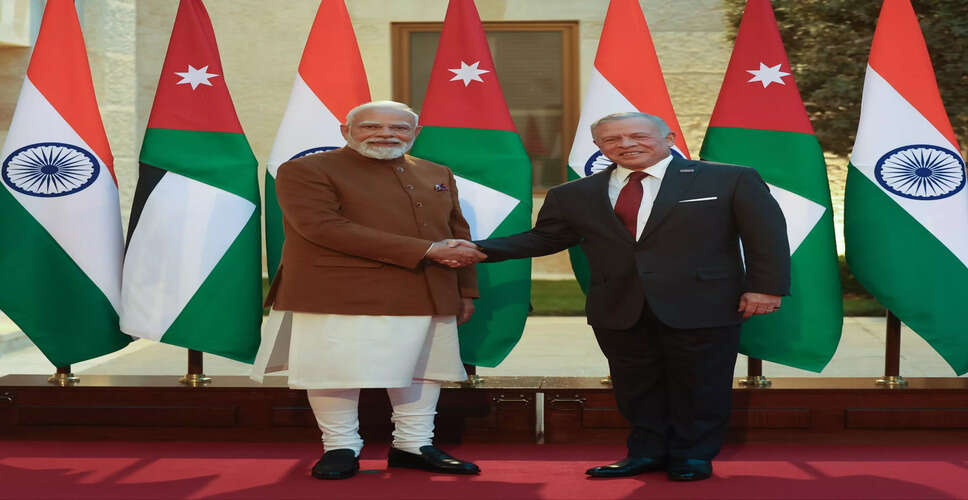
New Delhi, Dec 16: Prime Minister Narendra Modi's recent trip to Jordan has significantly advanced the bilateral relationship between India and the Middle Eastern nation, culminating in the signing of five Memorandums of Understanding (MoUs). These agreements cover various sectors, including renewable energy, water management, cultural exchanges, digital solutions, and a partnership between Petra and Ellora.
During his visit, PM Modi engaged in comprehensive discussions with King Abdullah II of Jordan, focusing on enhancing cooperation in trade, defense, renewable energy, agriculture, digital technologies, critical minerals, infrastructure, healthcare, education, tourism, and cultural exchanges.
The Prime Minister proposed a target to elevate bilateral trade to $5 billion within the next five years and suggested collaboration between Jordan's digital payment system and India's United Payments Interface (UPI). Jordan plays a crucial role as a fertilizer supplier to India, and both nations are exploring further investments to meet India's increasing demand for phosphatic fertilizers.
This visit marks PM Modi's first extensive engagement with Jordan, coinciding with the 75th anniversary of diplomatic relations between the two countries.
India ranks as Jordan's third-largest trading partner, with Jordan being a key supplier of phosphates and potash fertilizers to India.
Currently, approximately 17,500 Indian nationals reside in Jordan, primarily employed in sectors such as textiles, construction, manufacturing, and healthcare.
India exports various products, including cereals, frozen meat, and petroleum, to Jordan, while importing fertilizers, particularly phosphates and potash. The establishment of long-term joint ventures and Indian-owned manufacturing units in Jordan signifies a robust commercial partnership.
A notable joint venture, the Jordan India Fertiliser Company (JIFCO), was established between the Indian Farmers Fertiliser Cooperative (IFFCO) and the Jordan Phosphate Mines Company (JPMC) to produce and export phosphoric acid to India. This venture, initially valued at $860 million, serves as a significant source of phosphoric acid for the Indian market.
Additionally, over 15 garment-manufacturing companies owned by Non-Resident Indians (NRIs) operate within Jordan's Qualified Industrial Zones (QIZs), with a total investment of around $500 million. These companies produce garments in Jordan and export them under the Jordan-USA Free Trade Agreement framework.
The Indian-Jordan Center of Excellence in Information Technology, located at Al-Hussein Technical University (HTU), showcases the growing technological collaboration between the two nations. Fully funded by India, this facility boasts advanced IT infrastructure, including the Super Computer PARAM Shavak and comprehensive training programs. The Indian government also offers master trainer courses for Jordanian professionals in emerging fields like Cyber Security, Web Development, Machine Learning, and Big Data Analytics.