
Strengthening India-Canada Relations: A New Era of Strategic Partnership
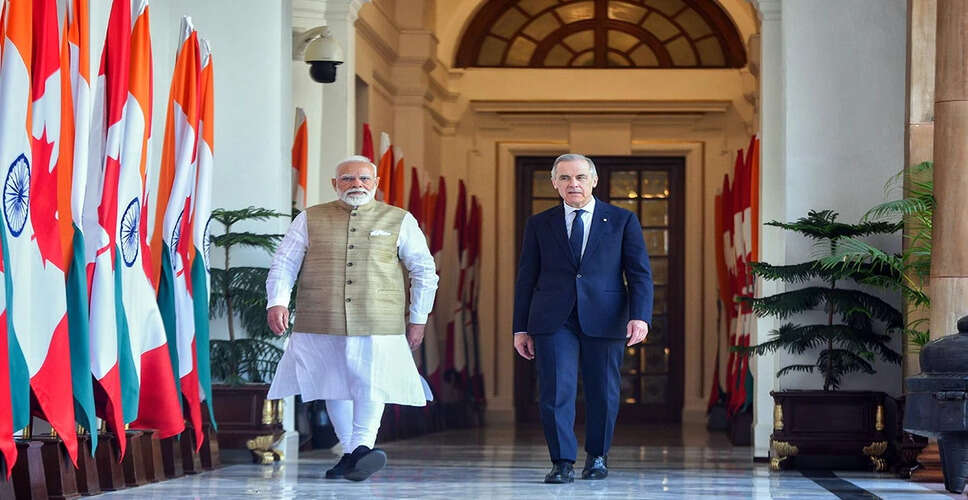
Forging Stronger Ties Between India and Canada
India and Canada are moving forward to enhance their relationship, putting past grievances behind them. The recent discussions between the Prime Ministers of both nations have resulted in agreements that are not only historic but also strategically significant. This high-level dialogue has signaled a new direction for bilateral relations, with Canadian Prime Minister Mark Carney's visit being viewed as a pivotal moment. In a joint statement, both leaders expressed their desire to elevate their partnership based on shared democratic values, respect for diversity, and a commitment to human welfare.
Economic Cooperation and Trade Goals
During the talks, both countries agreed to transform their relationship into a deeper partnership, prioritizing economic collaboration. They have set an ambitious target to increase bilateral trade to $50 billion by 2030. To achieve this goal, they decided to expedite the finalization of a comprehensive economic partnership agreement. This agreement aims to enhance trade in goods and services, investment, technological cooperation, and market access, which will boost investment flows and create new job opportunities in both nations.
Investment and Infrastructure Development
Canadian pension funds have already invested nearly $100 billion in India, reflecting their confidence in the country's development journey. Future investments are expected to grow in sectors such as infrastructure, green energy, technology, and manufacturing. Energy cooperation has emerged as a central pillar of this partnership, with a long-term uranium supply agreement in civil nuclear energy marking a significant achievement. This will strengthen India's energy security and promote stability in clean energy production, while collaboration on small modular reactors and advanced reactor technologies will modernize India's nuclear energy capabilities.
Commitment to Green Energy and Renewable Resources
Both nations have also pledged to collaborate in the field of green energy, focusing on renewable energy, green hydrogen, and energy storage. Canada's decision to join the International Solar Alliance and the Global Biofuels Alliance is seen as a crucial step in this direction. Agreements on critical minerals will help secure and diversify supply chains, with cooperation in lithium, nickel, cobalt, and other strategic minerals being vital for India's electric vehicle, semiconductor, and clean energy sectors. This will enhance India's role in the global supply chain and reduce dependency.
Defense and Security Cooperation
Defense and security cooperation was a key topic during the discussions. Both countries agreed to establish a defense dialogue, emphasizing maritime awareness, defense industry collaboration, and military exchanges. They reiterated their commitment to strengthening joint efforts against terrorism, extremism, and radicalization. Discussions also included promoting collaboration in technology and innovation, particularly in artificial intelligence, quantum technology, supercomputing, and semiconductors. New partnerships between universities and agreements for Canadian universities to open campuses in India will create new opportunities in the education sector.
Regional Cooperation and Strategic Balance
Canada's increasing involvement in the Indo-Pacific region and its interest in becoming a dialogue partner in the Indian Ocean Regional Organization will deepen maritime cooperation. Both leaders emphasized the need for dialogue and diplomacy to address the situation in West Asia. This emerging partnership between India and Canada is not merely an effort to boost trade; it signifies a broader strategic balance in the changing global landscape. Cooperation in energy, critical minerals, defense, and technology will provide long-term stability for both nations.
A Vision for the Future
For India, this partnership is a means to ensure energy security, diversify supply chains, and gain access to advanced technologies. For Canada, India represents a vast and dynamic market, as well as a reliable partner in the Indo-Pacific region. Strategically, this collaboration will enhance India's self-reliance, maritime security, and technological capabilities. Cooperation in critical minerals and nuclear energy will make India more competitive globally. The defense dialogue and maritime cooperation will bolster regional stability. If the proposed economic agreement is completed in a timely manner and the announced initiatives are effectively implemented, India-Canada relations could serve as a model for a balanced, sustainable, and multifaceted partnership on the global stage in the coming decade.