
Sonia Gandhi Criticizes Modi Government's Treatment of Student Protests

Sonia Gandhi's Strong Allegations Against the Government
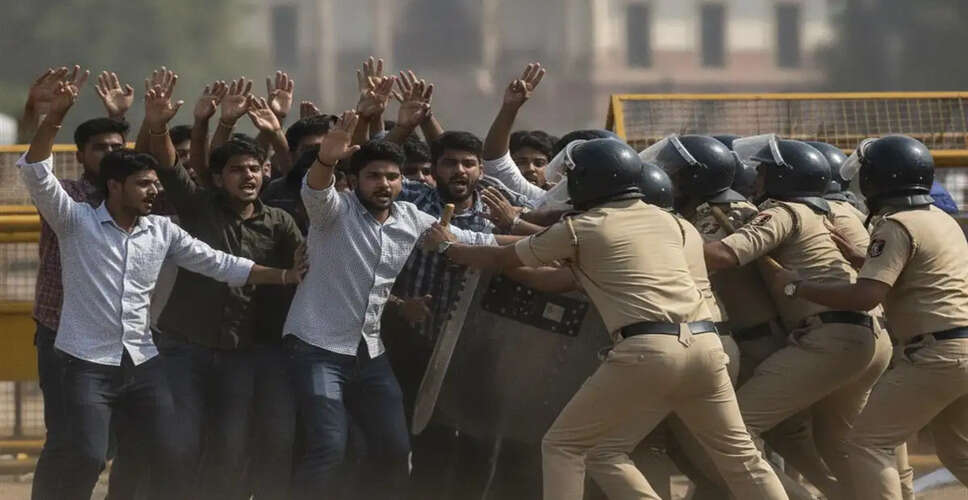
On July 24, in New Delhi, Sonia Gandhi, the leader of the Congress Parliamentary Party, accused the Narendra Modi administration of portraying students who are peacefully protesting against exam paper leaks and the decline of the education system as 'enemies of the nation.' In her article for an English daily, she expressed that the government is using oppressive measures to silence these students demanding accountability and reform in education.
Gandhi stated, 'The Modi government has responded to their bravery with cowardice and ruthless cruelty, treating them not as future leaders but as adversaries of the country.' She referred to the events of July 20 as a 'shameful day' when the Delhi police and Central Armed Police Forces resorted to 'unprovoked violence' to suppress the demonstrators.
Concerns Over Government's Approach to Dissent
She emphasized that this incident has shaken the collective conscience of society. Gandhi accused the Modi government of regularly opting for violence over dialogue, showing a clear tendency to suppress dissent from farmers to activists. Instead of engaging with future doctors, engineers, teachers, and public servants, the government has employed state repression against them, which she believes cannot be forgiven or forgotten.
The Congress leader claimed that the government has utilized an 'old toolkit' to label every dissent as anti-national in an attempt to discredit the student movement.
Education System Under Scrutiny
Gandhi criticized the government for reusing its old tactics to tarnish the student protests, suggesting that it should reflect on the policies that have led to these demonstrations. She highlighted three fundamental issues related to the education system, asserting that the budget allocation for school and higher education has decreased by 50% and 33%, respectively. She questioned, 'Is there any logic in such a regressive approach?'
She pointed out that nearly 100,000 government schools have been shut down in the last 12 years, while 43,000 private schools have been established, many of which are run by the Rashtriya Swayamsevak Sangh (RSS) and affiliated organizations.
Financial Burden on Families
Gandhi noted that the University Grants Commission (UGC) has cut funding for universities, forcing them to take loans at high-interest rates. She stated that the lack of quality and affordable public education has compelled Indian families to spend significant amounts on their children's education.
She claimed that the total expenditure on coaching for the National Eligibility cum Entrance Test (NEET) by families is equivalent to the total investment made by the Modi government in public education. 'The cost of obtaining private education discourages many talented students from ordinary backgrounds who possess immense potential,' she added.
Critique of Examination System
Sonia Gandhi raised concerns about the centralization, privatization, and politicization of the examination system, questioning the functioning of the National Testing Agency (NTA). She mentioned that there have been 152 instances of question paper leaks across the country in the past 12 years, including nine leaks in exams conducted by the NTA since its establishment in 2017.
She pointed out that the appointment of unqualified vice-chancellors based on partisan loyalty and the recruitment of politically connected but unqualified teachers have created a crisis in teaching at public universities.
Call for Accountability
Gandhi argued that the education system is becoming increasingly expensive, with rising corruption and growing difficulty in achieving success. She criticized the Modi government's 'deliberate and calculated policy' of avoiding accountability and constructive dialogue regarding education, calling it the 'final nail in the coffin.'
She also mentioned that the National Education Policy (NEP) 2020 was approved without broad consensus and parliamentary deliberation, and the NTA has never been brought before Parliament, remaining a society established by the central cabinet without adequate accountability mechanisms.
Conclusion: A Call to Stand with Students
Sonia Gandhi concluded by stating that despite these significant failures, the refusal of the education minister to resign has further inflamed public anger. She asserted that the student movement has emerged due to the dismal educational landscape and the Modi government's arrogance and unwillingness to be accountable or constructive.
She also referenced the police actions during protests against the Citizenship Amendment Act (CAA) and the National Register of Citizens (NRC), as well as unacceptable excesses against female wrestlers. 'The Modi government has not only worsened India's educational landscape but has also developed a habit of operating with impunity, extreme self-delusion, and utter insensitivity,' she remarked. Gandhi emphasized, 'Indian students have challenged the Modi government's deception. It is our moral, political, and constitutional duty to stand with them and protect their future.'