
Sonam Wangchuk Calls for Constructive Dialogue Following Release from Jail
Activist's First Remarks Post-Release
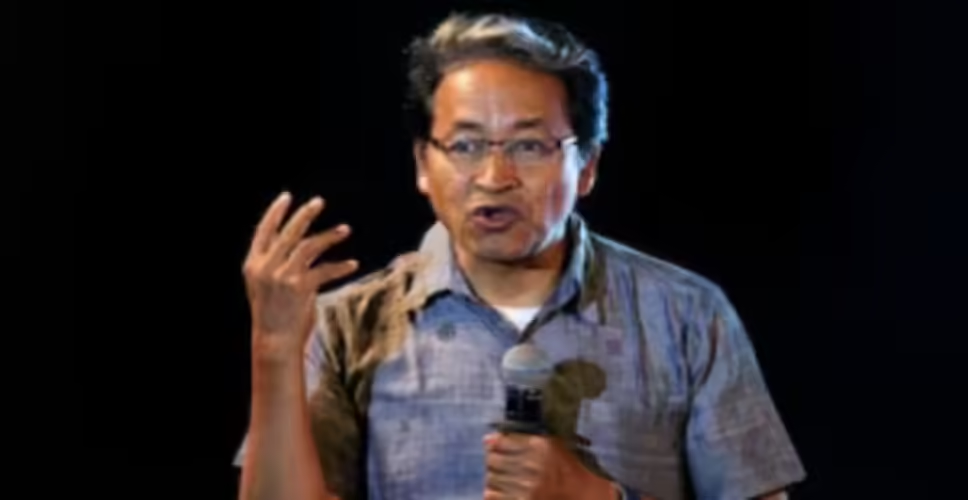
New Delhi: Activist Sonam Wangchuk made his first public comments after his release from incarceration, expressing a desire to view development in a "positive light" and hoping for a "meaningful dialogue" regarding the demands of protesting groups in Ladakh.
During a press conference alongside his wife and co-founder of HIAL, Gitanjali J Angmo, Wangchuk emphasized that the protests in Ladakh are focused on fostering a constructive dialogue.
He noted that discussions require a "give and take process," where both parties must be willing to make "certain accommodations."
"We were confident about winning in court, but a victory alone was insufficient. I aimed for a win-win situation," he stated.
Wangchuk expressed optimism that the Supreme Court would rule on the Habeas Corpus petition filed by his wife, setting a significant precedent.
He characterized the government's decision to release him as an "extension of a hand to build trust and facilitate meaningful, constructive dialogue."
"They have proposed a constructive dialogue, which is what we have sought. We endured significant struggles, including walking to Delhi and fasting. All movements in Ladakh aim to initiate this dialogue process," he remarked.
"Typically, we see individuals resorting to violence while the government calls for dialogue. In this case, the people are urging the government to engage in discussions," he added.
Wangchuk expressed hope that the dialogue would not only occur but would also be "meaningful and effective, leading to positive outcomes."
He addressed the situation in Ladakh, mentioning numerous "meaningless arrests," including individuals who were detained while attempting to donate blood.
He urged an examination of how the violence began, questioning, "Where did it start? How did this violence initiate? This needs to be investigated."
"There are concerns about how so many individuals suffered chest injuries. However, I believe these issues can be resolved. People can overcome their suspicions, and the government can withdraw their cases," he stated.
When asked about his next steps, Wangchuk indicated plans to travel to Ladakh to consult with leaders from the Leh Apex Body (LAB) and the Kargil Democratic Alliance (KDA), who have been leading the agitation for statehood and the extension of the Sixth Schedule to Ladakh over the past five years.
Regarding a potential return to protests, he clarified, "I have always stated that I do not wish to engage in hunger strikes; I feel compelled to do so. Now that the government is reaching out, we hope to set a positive example."
He emphasized that during discussions with the Centre, both sides should be flexible and accommodating.
"The primary issues at hand are safeguards under the Sixth Schedule, statehood, and the restoration of democracy. As I mentioned, it involves give and take. We hope to achieve progress on at least one of these fronts," he explained.
Wangchuk clarified that the decision-making power lies with the leaders in Ladakh.
"It should not result in a lose-lose situation for either side. A successful dialogue must be a win-win, where both parties accommodate each other," he concluded.
The climate activist shared that he utilized his time in Jodhpur jail for meditation and expressed gratitude to the jail staff, noting that despite his confinement, he felt the "warmth" of Jodhpur.
Wangchuk, aged 59, was detained on September 26 last year under the stringent National Security Act, just two days after violent protests resulted in four fatalities.
He was released from Jodhpur Central Jail on Saturday after the Union government revoked his detention immediately.
The LAB and KDA have been in discussions with the Ministry of Home Affairs regarding their key demands for statehood and inclusion under the Sixth Schedule, issues that have persisted since the region was designated as a Union Territory in 2019.
The organizations held rallies and organized a shutdown on Monday to demand the next round of talks, as promised during the high-powered committee meeting.
The last meeting of the high-powered committee, chaired by the Minister of State for Home Affairs, Nityanand Rai, occurred on February 4, where both groups called for the release of Wangchuk and 70 other detainees.