
Demands for Visually Impaired Students in Assam: A Call for Action

Concerns Raised by All Assam Blind Students' Union
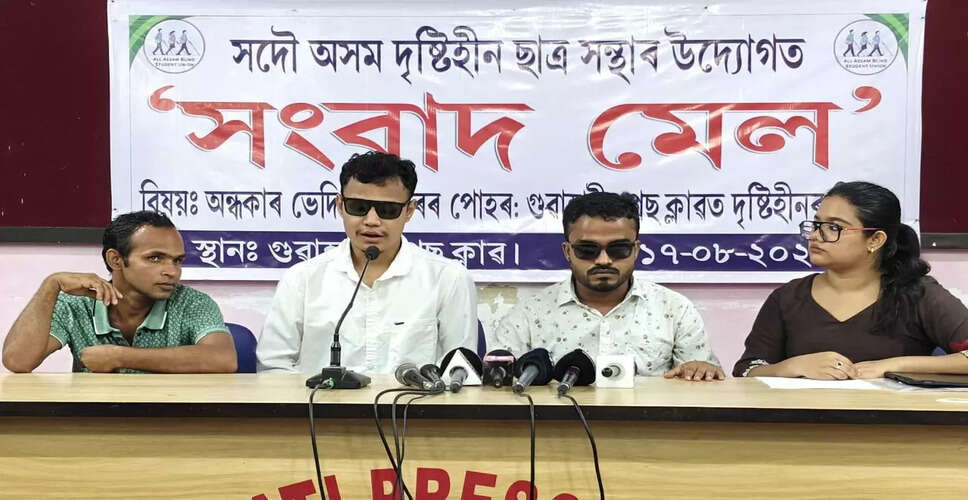
All Assam Blind Students' Union addressing a press meet in Gauhati Press Club on Monday (Photo: AT)
On August 18, the All Assam Blind Students’ Union held a press conference at the Gauhati Press Club, where they voiced urgent demands regarding education, employment, skill development, and social security for visually impaired students in Assam.
The union highlighted a critical shortage of Braille teachers and textbooks in educational institutions, which is significantly hindering the learning process for visually impaired students.
They also pointed out the absence of Braille textbooks, which is creating challenges for students trying to keep pace with their studies.
Concerns were raised about the teaching methods used for competitive and academic exams, particularly regarding the lack of suitable alternatives for map-related questions in history and the challenges faced in mathematics due to insufficient tools.
The union is advocating for enhanced skill development centers tailored for visually impaired students, aiming to equip them with necessary skills and improve their job prospects.
Additionally, they are calling for equitable opportunities for visually impaired candidates in the Assam Direct Recruitment Examination (ADRE).
Regarding higher education, the union noted that while there is a 5% reservation for visually impaired students, its implementation in Assam is lacking. They cited successful implementations at institutions like Jawaharlal Nehru University and the University of Delhi.
The union also urged the government to rectify inconsistencies in the Deen Dayal Divyangjan and pension schemes, as well as the Orunodoi scheme.
Moreover, they alleged that some individuals who are not visually impaired are exploiting benefits under the disability quota and called for measures to prevent such misuse.
Finally, the union requested the establishment of a high-level committee to investigate these issues and address the longstanding demands of visually impaired students in the state.