
Celebrating 256 Years of Durga Puja in Hailakandi: A Family Tradition

A Historic Celebration in Rangauti
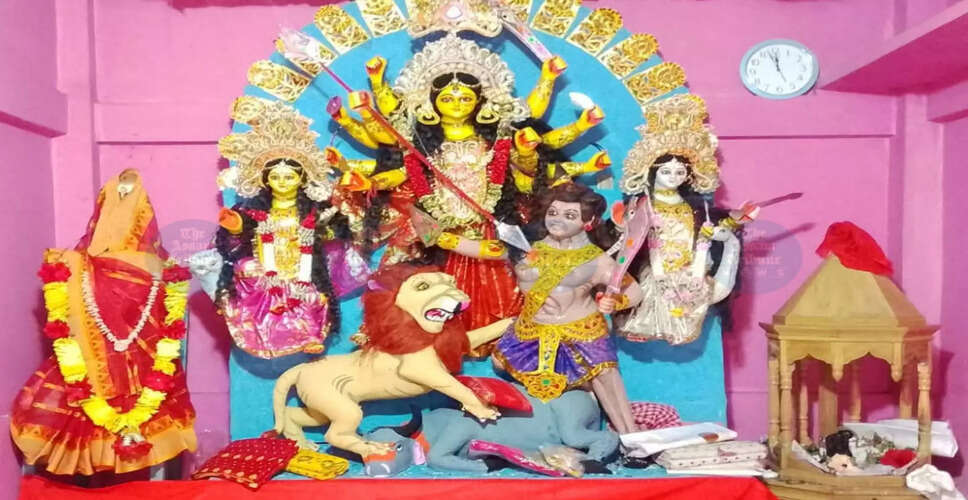
Unlike the conventional depiction of Durga accompanied by her children, the idol of 256-year-old Durga Puja in Hailakandi doesn't include idols of Ganesha and Kartikeya (Image)
Hailakandi, Oct 14: The sound of conch shells fills the air in Rangauti village as the Purkayastha family prepares to honor their nearly 256-year-old Durga Puja, a tradition enriched by royal patronage and deep-rooted family heritage.
Recognized as the oldest Durga Puja in the Hailakandi district, this family's annual homage to Goddess Durga has persisted through various challenges.
Although the family has lost its zamindari status and financial stability, they remain committed to upholding the rituals that have been passed down through generations.
The exact age of this puja is debated, but the family traces its origins back to the late 18th century.
Gurudas Purkayastha, a current family member, explains that the tradition began during the reign of Kachari King Krishnachandra, who assigned the worship duties to their ancestor, Masai Thakur.
“Our family’s Durga Puja tradition dates back nearly 256 years. It was initiated during the reign of Kachari King Krishnachandra, who later entrusted the worship to our ancestor,” Gurudas shared.
Kamaljyoti Purkayastha, another descendant, notes that their lineage originates from Satgaon in the Balisira region of the former Srihatta district, now part of Bangladesh.
From there, their ancestor migrated to Murkhargul village in the Bandukmara area of Barak Valley before finally settling in Rangauti.
“Our ancestors originally lived in Satgaon in the Balisira region of the erstwhile Srihatta district. Masai Thakur later moved to the Barak Valley and eventually settled in Rangauti, where our family’s legacy continued,” Kamaljyoti explained.
Masai Thakur served as the royal priest to King Krishnachandra, who conferred the title of Purkayastha upon him around 1770, although the Durga Puja had commenced nearly three decades prior to this.
Old remnants of walls on the family property serve as a testament to their historical significance, even as the scale of the celebrations has evolved over time.
In the past, the Durga Puja hosted by the Purkayastha family was a grand affair, featuring four days of worship along with yatra performances and musical events.
These festivities attracted visitors from Rangauti and surrounding areas, transforming the annual event into both a cultural and religious celebration.
However, financial limitations have since diminished the grandeur of the festivities. Traditional performances have been replaced with cultural programs.
Despite this, the family continues to gather for the annual worship, welcoming Anandamayi, the blissful mother, with heartfelt prayers.
Women in the family now play a crucial role in maintaining the tradition, ensuring that the rituals persist even with the reduced scale of celebrations.
The family adheres to the Shakta tradition of worshipping Goddess Durga, and their idol features a unique aspect: unlike the typical representation of Durga with her children, Ganesha and Kartikeya are notably absent.
Family members admit they are unsure of the reason behind this distinctive iconography, which has remained unchanged through generations.
The four-day worship concludes on Vijaya Dashami, when the idol is immersed in a pond on the family grounds, marking the end of the annual festivities.
Residents of Rangauti and nearby areas still partake in the puja, although the crowd is smaller than in previous decades.
For the Purkayasthas, the essence of the occasion lies not in its size but in the continuity of their cherished rituals.
Throughout Hailakandi, numerous traditional families continue to uphold ancestral Durga Puja customs.
For the Purkayasthas, this annual worship is a living legacy, nurtured by faith, familial ties, and a commitment to preserving a tradition that has thrived for over two and a half centuries.