
Significant Milestone Achieved in India's Bullet Train Project
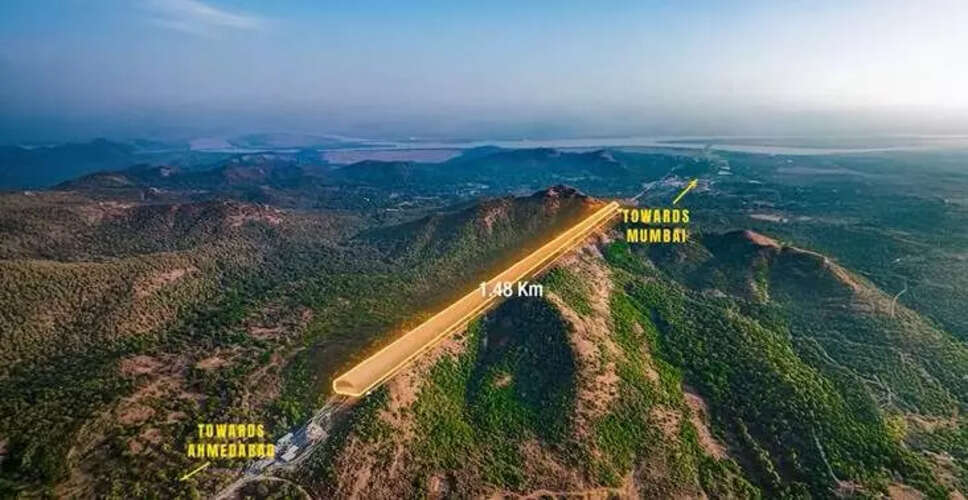
Major Tunnel Breakthrough in Maharashtra
New Delhi, Jan 2: Railway Minister Ashwini Vaishnaw celebrated a significant milestone on Friday as he oversaw the completion of a 1.5-km-long tunnel for the bullet train project in Maharashtra's Palghar district via a virtual event from Rail Bhawan in the capital, accompanied by chants of ‘Bharat Mata ki Jai!’
According to a statement from the Ministry of Railways, this mountain tunnel is one of the longest in the Palghar area, situated between the Virar and Boisar stations along the bullet train route. This marks the second tunnel breakthrough in Maharashtra, following the completion of a 5-km underground tunnel between Thane and BKC in September 2025.
Vaishnaw highlighted that the bullet train project offers nearly 95% savings in carbon dioxide emissions compared to road transport, emphasizing its environmental significance. He noted that many nations have pursued bullet train initiatives primarily for ecological reasons.
He cited South Korea as an example, where such projects have yielded substantial economic benefits alongside environmental gains. The bullet train's design allows it to reach city centers directly, reducing disruption to local communities and traffic, particularly in densely populated areas.
On Thursday, Vaishnaw indicated that India is expected to welcome its first bullet train by August 15, 2027.
The inaugural bullet train project spans 508 km between Mumbai and Ahmedabad, with 352 km located in Gujarat and Dadra and Nagar Haveli, and 156 km in Maharashtra.
The government anticipates that this corridor will link major urban centers such as Ahmedabad, Vadodara, Bharuch, Surat, Vapi, Thane, and Mumbai, significantly reducing travel time between the two metropolitan areas to approximately two hours, thereby enhancing inter-city connectivity.
As reported by the National High-Speed Rail Corporation Ltd. (NHSRCL), over 85% of the corridor, roughly 465 km, is being constructed on elevated viaducts, with 326 km already completed.
Vaishnaw further explained that for spans exceeding 40 meters, steel bridges are utilized due to their lighter weight and ability to support longer spans with enhanced strength. Consequently, bridges ranging from 40 meters to nearly 100-130 meters are all constructed using steel.
He added, "The Prime Minister has consistently emphasized the importance of adopting innovative working methods and establishing new standards for quality and technology. This project exemplifies that vision. Traffic cannot be halted, and trains cannot be stopped."
In November 2025, Prime Minister Narendra Modi conducted a thorough review of the Mumbai-Ahmedabad High-Speed Rail (MAHSR) project during his visit to Gujarat, marking a pivotal step in India's advancement towards modern transport infrastructure.
During this visit, the Prime Minister inspected the Surat station, which is designed to reflect the city's globally recognized diamond industry. The station stands at 26.3 meters tall and covers a built-up area of 58,352 square meters, featuring three levels: the ground floor for parking and security checks, the concourse level for lounges, restrooms, kiosks, and ticketing, and the platform level for passenger boarding.