
Shubhanshu Shukla: India's New Space Pioneer in Historic Mission
A Historic Moment for India
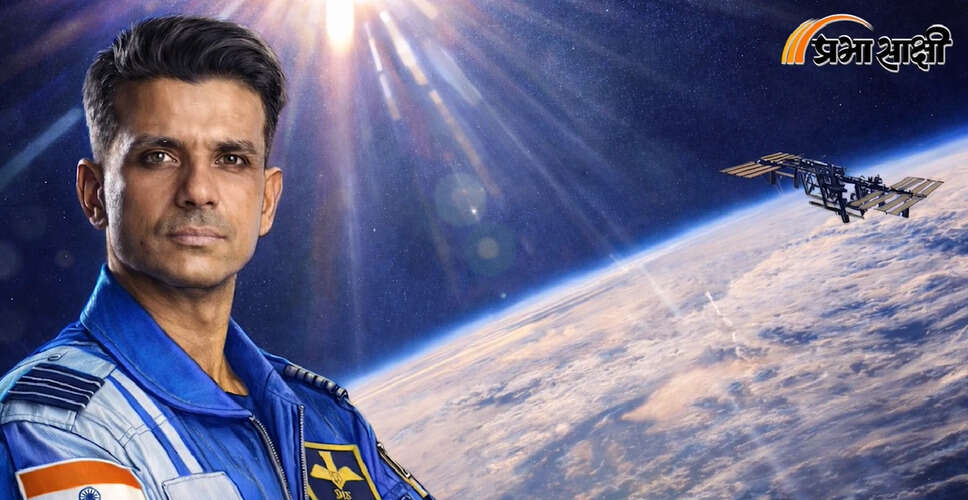
When former Prime Minister Indira Gandhi asked Rakesh Sharma, India's first astronaut, how India appeared from space, he famously replied, 'Saare Jahan Se Achha Hindustan Hamara.' On June 25, 2025, at precisely 12:01 PM, the heart of India beat in unison as SpaceX's Dragon spacecraft, attached to a Falcon rocket, ascended from the Kennedy Space Center in the USA. A new name etched in history emerged: Shubhanshu Shukla. After a 41-year wait since Rakesh Sharma's journey, this moment marked the return of an Indian to the threshold of space, with Group Captain Shubhanshu Shukla of the Indian Air Force leading the way. The Axium 4 mission, a collaboration between NASA and SpaceX, was not just a scientific endeavor for the West; it carried the hopes and aspirations of India. Before his flight, Shubhanshu expressed, 'This is not just my journey; I carry the dreams of 1.4 billion fellow citizens.' His words resonated as a heartfelt commitment to advancing India's space exploration. Initially scheduled for June 10, the mission was postponed by a day due to adverse weather conditions.
Who is Shubhanshu Shukla?
Shubhanshu Shukla is not only a decorated pilot but also a test pilot. His family's support has been instrumental in his achievements. His father, Rambhu Dayal Shukla, is a retired Joint Secretary from the UP Secretariat, while his mother has always encouraged his dreams. His wife, Kamya, is a dentist, and their six-year-old son, Kiyash, is thrilled to be part of this historic moment. Shubhanshu is the youngest among three siblings, with his sisters Nidhi and Suchi providing unwavering support. He is the first in his family to join the defense forces.
Shubhanshu's Journey from Space Station to Earth
Departure Burn: After separating from the space station, the spacecraft begins to orbit Earth. This process involves engine burns to move away from the station.
Phasing Burn: In this phase, the spacecraft adjusts its orbit to ensure it enters Earth's atmosphere at the right time, known as orbital phasing.
Deorbit Burn: The spacecraft ignites its engines one last time to reduce speed and altitude, preparing for atmospheric entry.
Trunk Separation: The trunk, which carries energy and support systems, is detached from the main capsule as it is no longer needed for the return journey.
Atmospheric Entry: This is the most challenging phase, where the spacecraft enters Earth's atmosphere at high speed and temperature, protected by a heat shield.
Parachute Deployment: Due to atmospheric friction, the spacecraft slows down, and parachutes deploy sequentially to ensure a safe descent.
Splashdown: Finally, the spacecraft gently lands in the ocean, a process known as splashdown, where the recovery team safely retrieves the crew.
Shubhanshu's Experiments for Gaganyaan Mission
To understand life in space, Shubhanshu Shukla conducted seven significant experiments crucial for the Gaganyaan mission. These aimed to explore how zero gravity affects life, covering topics like microalgae and seed germination. Studies on microorganisms will help determine how life can survive extreme temperatures. Research on muscle behavior in space aims to understand cellular responses and potential for regeneration. Additionally, studies on green algae investigate their growth in space, which could provide oxygen and food. The 'Voyager Display' study focused on the impact of spaceflight on eye movement and coordination.
Mission Duration and Collaborations
Shubhanshu Shukla and three other astronauts spent 18 days at the space station during their 20-day mission, with one day for travel to the station and another for the return. This marked the 18th mission by SpaceX to send humans into orbit, with India investing approximately ₹550 crores for Shubhanshu's participation.
To achieve optimal conditions, the mission was extended by four days. During their time at the space station, the astronauts completed over 60 scientific experiments and technical tests in collaboration with 31 countries, including the USA, India, Poland, Hungary, Saudi Arabia, Brazil, Nigeria, the UAE, and several European nations.
The mission commenced on June 26 from NASA's Kennedy Space Center in Florida, with the astronauts launching aboard SpaceX's Falcon 9 rocket and successfully docking with the International Space Station the following day. Originally planned for two weeks, the mission was extended by four days to secure favorable conditions for the return.