
Shashi Tharoor Challenges Andhra CM on Proposed Delimitation Framework

Tharoor's Thought Experiment on Delimitation
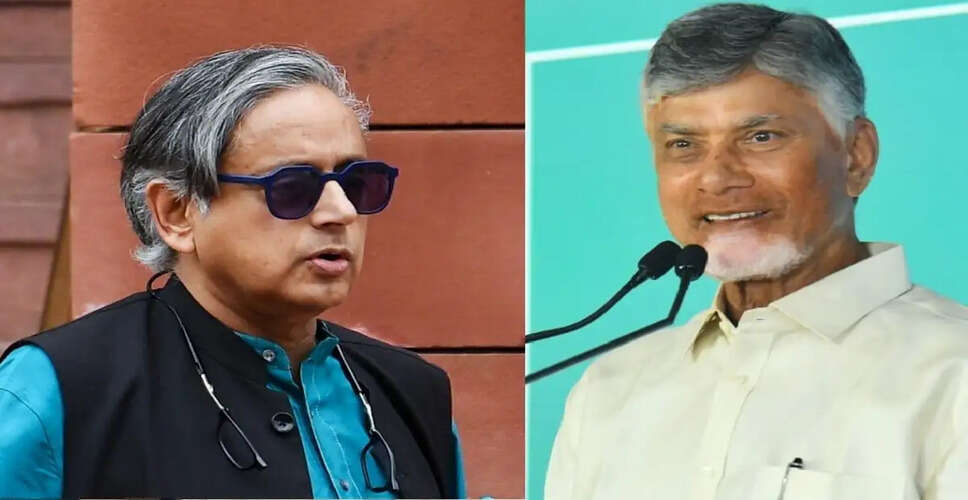
On Wednesday, Congress MP Shashi Tharoor expressed his disagreement with Andhra Pradesh Chief Minister N. Chandrababu Naidu's defense of the central government's proposed delimitation framework through a 'thought experiment.' Tharoor argued that even if the number of Lok Sabha seats were to increase uniformly across all states, the political influence would still lean towards larger states. This response from Tharoor came after Naidu criticized the opposition for blocking the constitutional amendment bill in Parliament, asserting that concerns regarding delimitation were unfounded.
The Constitution (131st Amendment) Bill, introduced during a special parliamentary session in April, proposed to raise the number of Lok Sabha seats from 543 to 850 by linking delimitation to the 2011 census. It also included a provision to proportionally increase the number of Lok Sabha seats for all states by up to 50%.
However, the bill failed to secure the necessary two-thirds majority, with 298 out of 528 voting in favor and 230 against it. A minimum of 352 votes was required for passage. Tharoor shared a newspaper clipping on social media with the headline, "Naidu stated - the delimitation bill will return with provisions for a 50% increase in seats." He wrote, "Naidu ji, let’s conduct a thought experiment. Suppose your salary is 2 lakh and your driver’s is 20,000. You announce a 50% increase for everyone. Now your salary becomes 3 lakh and your driver’s 30,000. The percentage increase is the same, but are you not in a better position compared to your driver?"
Tharoor noted that chief ministers from southern states have raised similar concerns, arguing that even if the proportional increase in seats remains consistent, the political balance would significantly shift. He posed a rhetorical question about whether it would make a difference if the number of MPs from Uttar Pradesh increased from 80 to 120 while Kerala's MPs rose from 20 to 30. He emphasized that despite the same ratio of increase, the disparity in political weight remains a serious concern, particularly when comparing Kerala's 10 MPs to Uttar Pradesh's 90. Tharoor concluded that proportional increases in seat numbers across states do not guarantee a balanced political landscape, especially for southern states that have long feared disadvantages in a population-based delimitation process.