
Severe Smog Engulfs Delhi as Air Quality Plummets
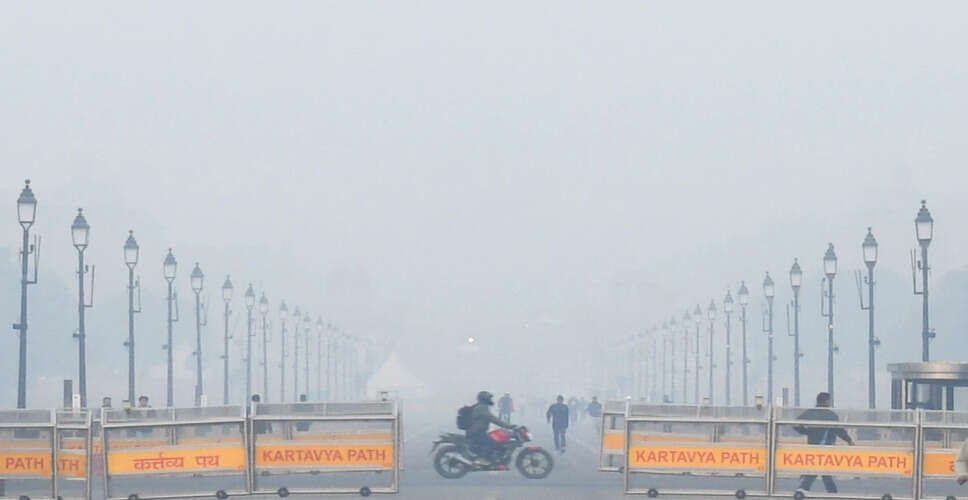
Delhi's Air Quality Deteriorates
On Saturday, a thick layer of smog enveloped the capital, with the Air Quality Index (AQI) recorded at a concerning 333, categorizing it as 'very poor.' This figure was slightly higher than the previous day, and the city continued to experience cold weather. According to the India Meteorological Department, Friday marked the coldest morning of December so far, with temperatures dropping to 5.6 degrees Celsius.
Data from the Central Pollution Control Board (CPCB) at 7 AM indicated that Mundka had the worst AQI at 381. Out of 39 monitoring stations in Delhi, 35 reported readings in the very poor range, while the remaining four stations indicated poor air quality.
Monitoring Stations Report Poor Air Quality
The stations that recorded very poor air quality included RK Puram (364), Punjabi Bagh (348), Chandni Chowk (348), Rohini (374), Vivek Vihar (309), Bawana (375), Siri Fort (343), Wazirpur (359), Anand Vihar (366), Ashok Vihar (348), and Sonia Vihar (352). The locations with poor air quality readings were NSIT Dwarka (260), Mandir Marg (256), IGI Airport (263), and Aaya Nagar (289).
According to CPCB standards, an AQI of 0 to 50 is considered 'good,' 51-100 'satisfactory,' 101-200 'moderate,' 201-300 'poor,' 301-400 'very poor,' and 401-500 'severe.'
Pollution Sources Identified
The Decision Support System (DSS) for air quality management in Delhi identified vehicle emissions as the largest local contributor to pollution, accounting for 15.3%. Industrial contributions in Delhi and surrounding areas were noted at 7.6%, followed by residential sources (3.7%), construction dust (2.1%), and waste burning (1.3%). The DSS analysis also highlighted pollution levels in nearby NCR districts, with Jhajjar at 14.3%, Rohtak at 5%, Sonipat at 3.8%, Bhiwani at 2.5%, and Gurugram at 1.5%.
Throughout the week, Delhi's air quality fluctuated significantly. The AQI was 279 on Sunday, rising to 304 on Monday, and peaking at 372 on Tuesday, nearing the 'severe' category. It slightly decreased to 342 on Wednesday, remained at 304 on Thursday, and recorded 327 on Friday.
Expert Insights on Air Quality
Commenting on the air quality in the capital, Mohammad Rafiuddin, Program Lead at the Council on Energy, Environment and Water (CEEW), noted that most days last week, Delhi remained in the 'very poor' category. He referenced DSS data indicating that with a reduction in stubble burning, emissions from vehicles, homes, and construction have become the primary sources of PM2.5.
He emphasized the need for strict enforcement of Stage II restrictions under the revised Graded Response Action Plan (GRAP), which requires authorities to rigorously implement dust control at construction sites, prohibit the entry of vehicles below BS-IV standards, and stagger office timings.
Weather Forecast for Delhi
Meanwhile, the India Meteorological Department forecasts light fog for Saturday, with temperatures expected to range between 8 degrees Celsius and 23 degrees Celsius. On Friday, the maximum temperature in the capital was recorded at 23.5 degrees Celsius, while the minimum dropped to 5.6 degrees Celsius, marking a 3.9-degree deviation from the norm and the lowest temperature of the season so far.
The weather department reported that humidity levels reached 68% around 5:30 PM, having peaked at 100% in the morning. Previously, the coldest December morning recorded was 4.5 degrees Celsius on December 12, 2024.