
Severe Rainfall Disrupts Life in Delhi: Streets Submerged and Traffic Halted

Impact of Heavy Rainfall in Delhi
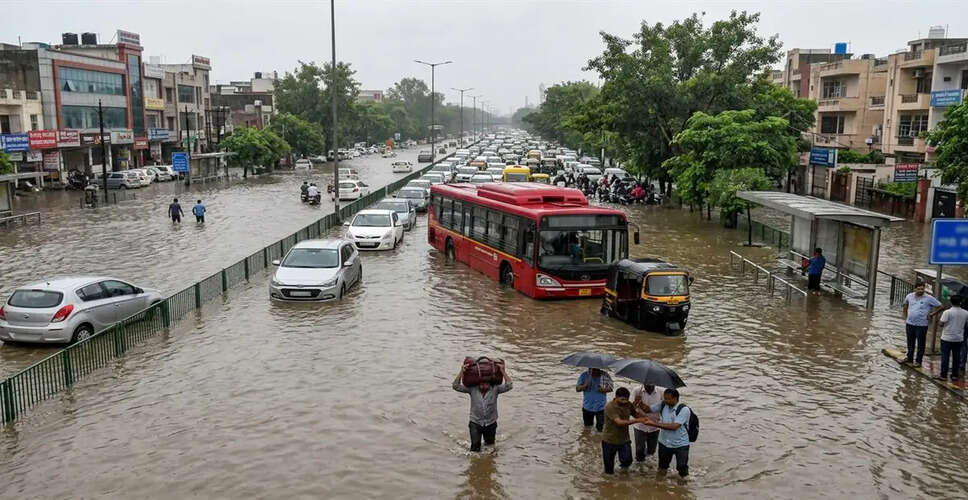
On August 7, heavy rainfall in Delhi caused significant disruption to daily life. The India Meteorological Department (IMD) issued a red alert as major roads became submerged under four feet of water, leading to stranded vehicles and halted traffic. Areas from Mahrauli-Badarpur Road in South Delhi to Mahipalpur, Minto Road, ITO, Shakarpur, and Chhatarpur were severely affected.
Passengers found themselves stuck in traffic jams for hours, while drivers abandoned their vehicles on flooded roads. Commuters faced challenges in booking cabs to reach their destinations. The worst flooding occurred on Mahrauli-Badarpur (MB) Road near the Air Force Station, where water levels reached three to four feet, transforming one of South Delhi's busiest routes into what locals described as a river.
Traffic crawled for several kilometers between Khanpur and Okhla Mor, while roads near Sangam Vihar, Devli, and Ambedkar Nagar remained completely inundated. Residents in Valmiki Basti, Fatehpur Beri, were seen wading through waist-deep water. Local residents helped school children cross the flooded streets using makeshift boats made from large blue tarpaulins.
Many families reported damage to food supplies and household items due to water entering their homes. Following the torrential rain, numerous complaints regarding civic amenities flooded the administration, with at least 67 reports of flooding, fallen trees, and power outages.
Continuous rainfall led to severe flooding in areas surrounding the Red Fort, Chhatarpur Farm, near Terminal-1 in Meharam Nagar, and Soldier Farms. The waterlogged Mahipalpur T-point severely impacted traffic heading towards the airport, Gurugram, Chhatarpur, and Vasant Vihar, while passengers faced long delays near Pusa Road roundabout. Images from Chhatarpur showed school students navigating through knee-deep water, while vehicles struggled through submerged sections of MB Road.
Additionally, reports indicated significant flooding at the Narcotics Control Bureau office in South Delhi. Traffic was also affected in East Delhi areas like GT Road, GTB Enclave, and Dilshad Garden. E-rickshaw drivers in Shakarpur and nearby Mandawali reported accidents due to overflowing drains and potholes filled with water, which severely impacted their livelihoods.
One e-rickshaw driver expressed frustration, stating, 'There are many issues. Potholes fill with water, making it hard to see sewer holes. Today, at least three to four vehicles overturned, including e-rickshaws, scooters, and motorcycles.' He noted that poorly constructed drains clogged with debris prevent quick drainage after rain.
The driver added, 'Our earnings have significantly dropped. We used to make around 600 rupees a day, but now we only earn 200 to 300 rupees. Water damages the battery. If an e-rickshaw flips, it can lead to losses of 60,000 to 80,000 rupees.' Residents of Fatehpur Beri mentioned that flooding has been a persistent issue for decades. According to the MCD's central control room, incidents of fallen trees were reported from Keshavpuram, South, Central, West, and Civil Lines areas. The New Delhi Municipal Council (NDMC) received 34 rain-related complaints, including 15 for flooding, five for fallen trees, and 14 for power outages.
Meanwhile, the Public Works Department (PWD) recorded 22 complaints regarding flooding. Reports of waterlogging came from various locations in the NDMC area, including Lodhi Road, Sunheri Bagh Road, RK Ashram Marg, Minto Road Bridge, Rajiv Chowk Metro Station, Safdarjung Flyover, Lady Hardinge Medical College, Motibagh, Talkatora Garden, Race Course Road, and Sarojini Nagar. Additionally, reports of fallen trees were received from Lady Hardinge Medical College, Chanakyapuri's Yashwant Place, RMAL Hospital, and Jamnagar House.
The heavy rainfall has also sparked political debates. The Delhi Congress blamed the central government, the Delhi government, and the Municipal Corporation of Delhi (MCD) for the severe flooding across the city. Senior Congress leader and former MLA Mukesh Sharma accused the government of failing to clean the drains, which he claimed was only done on paper.
He stated, 'Despite repeated assurances, this triple-engine government has completely failed to prevent flooding. There is hardly a road in Delhi—whether in densely populated colonies, residential areas, villages, or urban regions—that is free from flooding. The government's claims of keeping Delhi flood-free have proven to be hollow.'
On the other hand, the Aam Aadmi Party (AAP) posted on social media, criticizing the BJP for taking credit for resolving flooding issues at Minto Bridge while ignoring the flood-like conditions in other parts of the city.
As of now, there has been no immediate response from the Delhi government, led by Rekha Gupta, regarding the opposition's accusations. The IMD forecasted moderate rainfall in several areas of Delhi over the next few hours, with the possibility of thunderstorms and heavy rain in some locations. According to IMD data, the highest rainfall of 111.5 mm was recorded in Pushp Vihar between 8:30 AM and 5:30 PM. Following that, Chhatarpur received 104.5 mm, Ayanagar 87.4 mm, Palam 73.5 mm, Janakpuri 68 mm, Jharoda Kalan 67 mm, Pusa 59.5 mm, Safdarjung 57.3 mm, Naraina 53 mm, Ridge 49.6 mm, Lodhi Road 49.3 mm, Mayur Vihar 36 mm, Najafgarh 24 mm, and Jafarpur 13.5 mm. According to IMD statistics, Delhi recorded 127 mm of rainfall in the first week of August, marking the highest rainfall for this week since 2011.