
Scott Simmons: The Architect Behind India's Distance Running Success at the Asian Games

Introduction to Scott Simmons' Impact
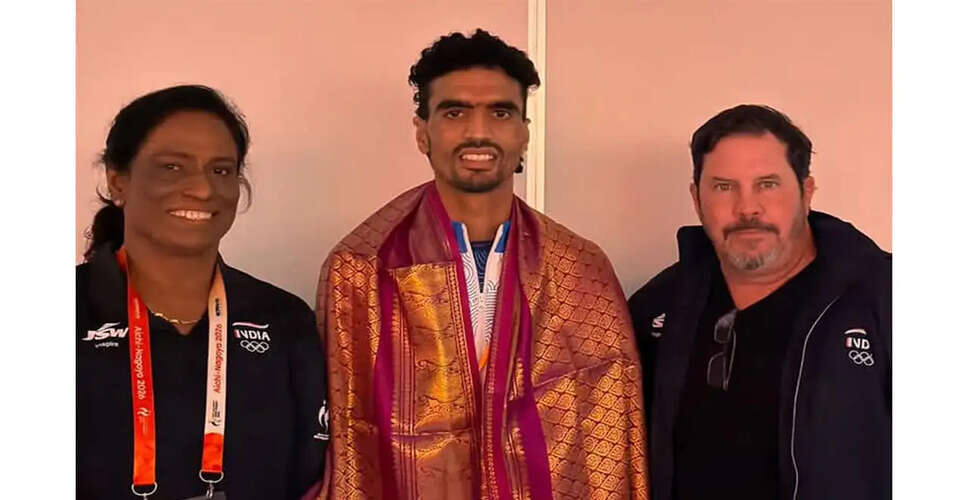
American coach Scott Simmons has played a pivotal role in India's remarkable achievements in distance running during the 2026 Asian Games. Athletes Gulveer Singh, Seema Kumari, and Sawan Barwal, who excelled in Aichi-Nagoya, have trained rigorously under his guidance at a high-altitude facility in Colorado Springs, USA.
Gulveer Singh's Remarkable Journey
Gulveer Singh showcased an impressive performance in Nagoya, competing four times over five days and securing three medals: silver in both the 10,000m and 1,500m, along with a bronze in the 5,000m. This achievement followed his historic two-medal win at the Commonwealth Games 2026 in Glasgow, where he earned silver in the 10,000m and bronze in the 5,000m.
Simmons, who coaches Gulveer in Colorado Springs, explained that their training strategy was primarily focused on the 10,000m event, which inadvertently enhanced his performance in shorter races. "We prepared thoroughly for the 10,000m, and Gulveer excelled, earning silver. While we believed it was his strongest event, it also set him up well for the 1500m," Simmons stated in an interview.
The Philosophy of Consistency
Simmons reflected on his initial observations of Indian distance runners when he arrived in Bengaluru in early 2022, describing the discipline as a 'sleeping giant.' He emphasized the need for time, support, and consistent training to unlock their potential. "We required time and backing from the Indian government, the Target Olympic Podium Scheme (TOPS), the Athletics Federation of India (AFI), and other stakeholders to provide these athletes with the right training opportunities and the time to develop their skills," he remarked.
The AFI, with support from the Union sports ministry, made a significant effort to send athletes like Gulveer back to the United States for an uninterrupted six-month training period before Nagoya. This extended training allowed him to consistently practice in Colorado Springs and compete with high-caliber international athletes.
Sawan Barwal's Historic Marathon Achievement
Sawan Barwal also thrived in this environment, achieving a landmark performance in Nagoya by winning silver in the men's marathon with a time of 2:11:37, breaking his own national record and ending India's 44-year wait for an Asian Games marathon medal. Simmons noted that Barwal's development was meticulously planned, despite his limited experience in marathons.
He praised Barwal's training alongside seasoned marathoners in Colorado Springs, stating, "He has been able to train with athletes at that level. While he faces challenges due to his youth and inexperience, this was a solid build-up, and he will improve further with more marathon-specific training, potentially leading to qualification for the Beijing World Championships."
Collective Growth in a Supportive Environment
The progress seen is not limited to Gulveer and Barwal. Simmons highlighted the achievements of other Indian athletes in his training group, including Seema Kumari, who earned bronze in the women's 10,000m in Nagoya, marking India's first medal in this event since 2010. He noted that the shared training environment fosters collective improvement, where athletes learn from each other and strive for higher standards.
"When we train together, everyone improves, and we witnessed that with the Indian athletes' performances in Nagoya," Simmons commented.
Future Aspirations for Los Angeles 2028
Looking forward to the Los Angeles 2028 Olympics, Simmons expressed confidence that the Indian athletes training in Colorado Springs now believe in their ability to qualify, even as the standards become more stringent. He emphasized that training alongside peers who are also aiming for Los Angeles creates a competitive atmosphere conducive to improvement. "They believe they can qualify, and the qualification process is tougher than ever," Simmons noted.
He also suggested that two to four younger Indian athletes should be integrated into the long-distance program now, as reaching this level of proficiency may take two to four years.