
Rising Tensions in Hormuz Strait Amid US-Iran Ceasefire Deadline

Increased Tensions in Hormuz Strait
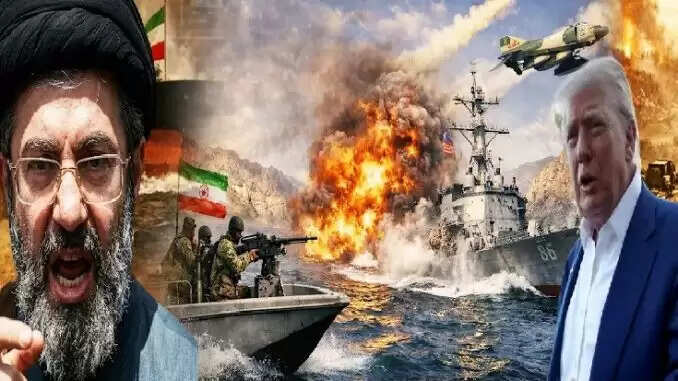
New Delhi. As the deadline for the ceasefire between the United States and Iran approaches, tensions in the Hormuz Strait are escalating once again. Following the announcement of the Strait's reopening, the Islamic Revolutionary Guard Corps Navy has established certain conditions for vessels attempting to navigate through the area. A post on social media indicated that permission from the IRGC Navy is mandatory for all types of maritime traffic.
Civilian vessels are only permitted to follow routes designated by Iran, while military ships are still prohibited from passing through. Failure to obtain permission could result in the Strait being closed again. The IRGC has referred to these conditions as a 'new arrangement,' asserting that they align with the terms of the ceasefire agreement. However, this statement lacks the details that Araqchi did not clarify when he announced that all commercial vessels would have unrestricted access during the ceasefire.
What did Araqchi say? He stated, “In accordance with the ceasefire in Lebanon, the route for all commercial vessels through the Hormuz Strait is declared fully open for the remaining duration of the ceasefire. This will be along the coordinated route previously announced by Iran's Ports and Maritime Organization.” Prior to this, several Iranian state media outlets criticized Araqchi's announcement. Tasnim labeled his post as “flawed and incomplete,” warning that it created unnecessary ambiguity regarding the reopening of the Strait.
Trump's Confirmation Meanwhile, U.S. President Donald Trump confirmed on social media that the Hormuz Strait is “completely open.” Trump wrote, “Iran has just announced that its waterway is fully open and ready for complete navigation.”
‘Seven False Claims in One Hour’ Tensions between Iran and the U.S. have once again reached a peak. While attempts at dialogue continue, the exchange of statements has further heated the situation. Iranian Parliament Speaker Mohammad Baqer Qalibaf stated that the U.S. President made seven claims in one hour, all of which were false. However, Qalibaf did not specify which statements he was referring to. He issued a stern warning to Trump, stating that if the U.S. maintains its naval blockade, Iran may be compelled to close the Hormuz Strait.
Ship Movements Restricted to Designated Routes Qalibaf wrote on the social media platform X that the movement of ships through Hormuz will only occur based on designated routes and Iranian permission. He made it clear that if the blockade continues, the waterway will not remain open.
Trump's Major Claims Regarding Iran President Trump has made several significant claims about Iran. According to him, Iran has agreed to keep the Hormuz Strait open and never close it. He also stated that the U.S. naval blockade at Iranian ports will remain in effect until a final agreement is reached between the two nations.
Trump further claimed that discussions with Iran would progress starting Sunday, aiming to take concrete steps towards a permanent ceasefire. He indicated that Iran is assisting the U.S. in removing mines from maritime routes.
Additionally, he asserted that Iran would hand over its enriched uranium to the U.S. and agree to suspend its nuclear program indefinitely. Trump also claimed that the U.S. and Iran would work together to remove uranium from Iran's nuclear sites.
U.S. Stance: Naval Blockade to Continue This statement came shortly after Iran announced that all commercial vessels would have complete access to the Hormuz waterway during the ceasefire period. Iranian Foreign Minister Mohammad Baqer Qalibaf stated that this arrangement would only apply based on pre-established routes. However, shortly thereafter, President Trump adopted a tougher stance, asserting that the naval blockade against Iran would remain until an agreement is reached. He also claimed that obstacles in the negotiations would be resolved soon.