
Revival of Traditional Dong Irrigation System Transforms Lives in Assam
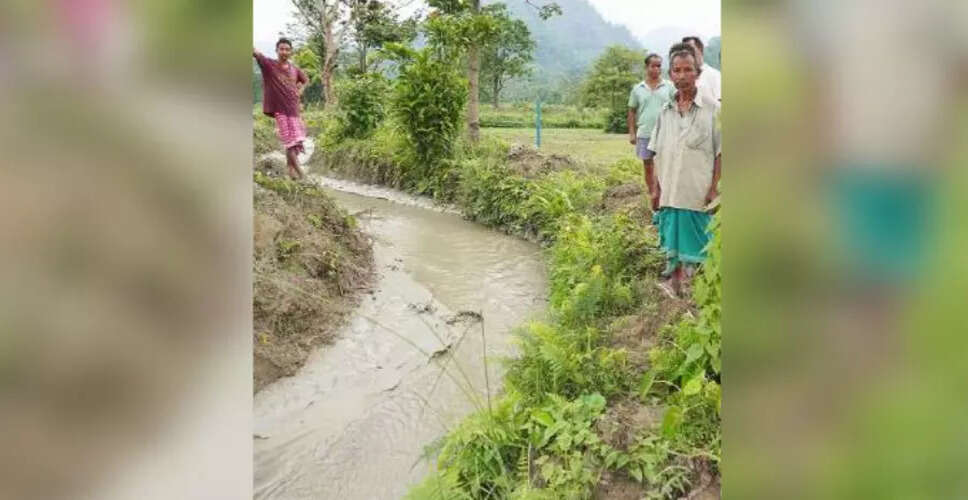

Restoration of Dong Irrigation System
For generations, the traditional dong irrigation system has served as a lifeline for rural communities.
Standing next to the recently revitalized 1.5-kilometre Nonaikhas Dong in Assam's Udalguri district, farmer Rameswar Basumatary reflected on the struggles his community faced for nearly 14 years.
He shared, “It was a unique challenge for us. Despite a perennial river flowing near our village, we struggled daily to gather water for our homes and farms. Our dong bandh was destroyed by floods in 2012, leaving the main canal unusable.”
This situation persisted until January 2026, when the village's traditional dong irrigation system was restored.
Fellow villager Jiten Bora expressed, “Our lives and livelihoods have been revitalized. The restoration of the dong has brought significant relief to our farming community.”
In the Bhabar-Terai region of the Bodoland Territorial Region (BTR), situated at the foothills of the Bhutan Himalayas, water scarcity and management have long posed challenges for residents in Udalguri, Baksa, Chirang, and Kokrajhar districts.
Historically, the traditional dong irrigation system has been crucial for rural communities, supporting paddy farming, vegetable production, and other crops, while also ensuring water supply for livestock and household ponds, thereby enhancing food security and reducing drought vulnerability.
The dong system, an age-old indigenous water management technique developed by the Bodo community, consists of gravity-fed earthen canals that channel water from rivers, streams, and wetlands to agricultural fields and villages.
The geographical features of the BTR make these dongs essential. The region's sloping terrain, rocky soils, and rapid runoff mean that while annual rainfall is plentiful, much of it quickly drains away. Accessing groundwater can be challenging due to hard, rocky surfaces and high iron content in some areas.
The system operates on straightforward yet effective indigenous engineering principles:
- Main canal (dong): Earthen canals divert water from perennial rivers, streams, or wetlands.
- Diversion bunds: Temporary or semi-permanent structures made from bamboo, stones, logs, and earth raise the water level and direct flow into the canal.
- Gravity flow: Water moves naturally downhill without the need for pumps or external energy.
- Distribution network: The main canal branches into smaller channels that deliver water directly to fields and household ponds.
Regular maintenance is necessary for dongs. Villagers and local Dong Bandh Committees often carry out desiltation work with limited resources. However, severe flooding frequently leads to significant siltation and damages the diversion bunds at the canal intake.
A recurring issue arises when floodwaters wash away the diversion bund. In many instances, the costs and labor needed for repairs exceed the community's capacity, leaving numerous dong systems nonfunctional for years and threatening the livelihoods of thousands of farming families.
Additionally, many villages experience ongoing human-elephant conflicts, further complicating the already precarious rural livelihoods.
In response to the challenges posed by dysfunctional dongs and human-elephant conflicts, Aaranyak, a leading conservation organization in the region, initiated a project to restore aging and nonfunctional irrigation channels with support from LIC Housing Finance Limited.
This initiative has successfully restored several dongs across the landscape, particularly in Udalguri district, including Bhabai Dong, Bhola Dong, Bholatar Dong, Orang Dong, Newli Dong, Orangajuli Dong, Nonaikhas Dong, Gaobura Bast Sakha Dong, Sikaridanga Monai River Dong, Amlaiguri Dong, and Moromi Bheta Dong.
Dr. Partha Jyoti Das, a respected environmental scientist, provided technical guidance for the restoration of these traditional irrigation systems.
Collectively, these efforts have revived approximately 20 kilometers of dong networks across at least 11 villages, benefiting around 1,452 households, irrigating nearly 7,000 bighas of agricultural land, and improving the lives of an estimated 7,500 individuals. While the number of beneficiaries may seem modest, the positive impact on their lives has been significant.
The restoration work focused on desiltation of canals, re-establishing proper channel gradients, and repairing diversion bunds at intake points. Communities have since taken charge of managing and maintaining the systems themselves.
Among the beneficiaries is Niranjan Daimari from Mazbat, one of over 600 individuals served by the restored three-kilometer Sikaridanga Monai River Dong.
He remarked, “The revived dong has enabled us to irrigate our paddy fields and horticultural crops, and even replenish our household fish ponds.”
Sanjit Swargiary emphasized the agricultural benefits resulting from the restoration, stating, “Our village harvested a bumper paddy crop this year following the revival of the dong,” and suggested that such initiatives should be expanded across the region to bolster farmers' economic conditions.
In a time of increasing climate uncertainty, these age-old irrigation networks continue to demonstrate their importance. By restoring the flow of water through dormant canals, not only is agriculture revitalized, but hope, resilience, and prosperity are also renewed.