
Revitalizing Assam's Sarthebari Bell Metal Industry: Government Initiatives and Challenges

Government's Commitment to Bell Metal Artisans
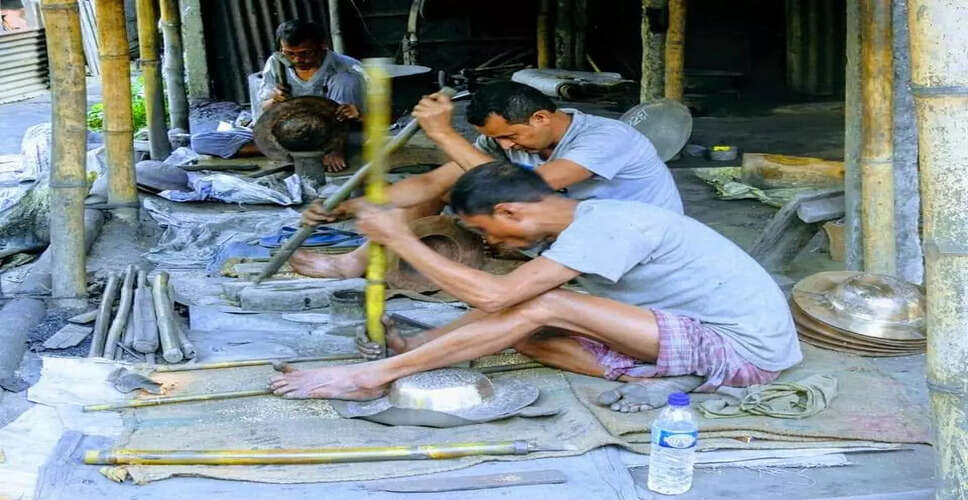
Guwahati, July 9: The Legislative Assembly recently focused on the Sarthebari bell metal industry, a traditional craft in Assam, as lawmakers discussed the challenges faced by artisans. The state government has proposed a comprehensive plan aimed at revitalizing this age-old craft through improved infrastructure, financial support, and enhanced market access.
During the fourth day of the Budget Session, Industries and Commerce Minister Bimal Borah emphasized the importance of the Geographical Indication (GI) tag for Sarthebari bell metal products. He stated that this designation would protect artisans from counterfeit goods and bolster the industry.
"The GI tag is crucial for safeguarding artisans' interests and curbing the sale of imitation products, thereby strengthening the bell metal sector," Borah informed the Assembly.
The minister recognized the various challenges confronting the industry and mentioned that the government has initiated several supportive measures for artisans.
Addressing concerns regarding the disbursement of funds, Borah noted that only half of the Rs 1 crore allocated for the sector had reached the intended beneficiaries. He assured the Assembly that this issue would be investigated.
"The government allocated Rs 1 crore for the industry, but it has come to my attention that only Rs 50 lakh has been distributed to artisans. I will instruct the relevant departments to look into this matter," he stated.
Borah also revealed plans to revitalize the long-neglected bell metal development center and create a dedicated craft village.
He mentioned that approximately 60 bighas of land had been designated for the center back in 1989, but it has since fallen into disrepair.
"We have developed a scheme for its redevelopment, which includes improved road access. Additionally, we aim to establish a marketing and sales center to empower artisans towards self-sufficiency," he added.
The minister informed the Assembly that a four-year roadmap for the industry's revival has been prepared, with budget allocations already included in the current financial year's budget.
Highlighting the support provided to artisans, Borah noted that 254 beneficiaries who secured bank loans in 2019-20 received a total of Rs 4.27 crore in financial assistance.
Under the PM Vishwakarma Scheme, 32 artisans have received identity certificates, 26 have been provided with advanced toolkits, and six have obtained loans of up to Rs 1 lakh.
He further mentioned that artisans would also benefit from the Mukhya Mantri Atmanirbhar Asom Abhijan, and 32 craftsmen have undergone specialized packaging training at the Indian Institute of Packaging in Delhi.
The discussion was initiated by Asom Gana Parishad MLA Dipak Kumar Das, who expressed concerns about the survival of the traditional craft due to rising raw material costs and competition from cheaper alternatives.
"The prices of copper and tin have surged. Bell metal products are facing tough competition from stainless steel utensils, while counterfeit items are inundating the market," Das remarked.
Das reiterated allegations that only Rs 50 lakh of the sanctioned Rs 1 crore had been utilized for raw material procurement, claiming that the remaining funds had not been released by district administration and relevant officials.
He pointed out that the traditional craft extends beyond Sarthebari, being practiced in villages like Lasima, Boniyakuchi, Namxala, and Karakuchi.
Despite securing the GI tag, only 240 artisans have registered under this framework so far.
Das urged the government to expedite the registration process for more artisans under the GI system and to hasten the establishment of a craft village to promote this heritage industry as a tourism attraction.