
Regulatory Authority Orders Removal of Controversial Shows Linking NCERT Textbook to Love Jihad
Regulatory Action Against News Channels
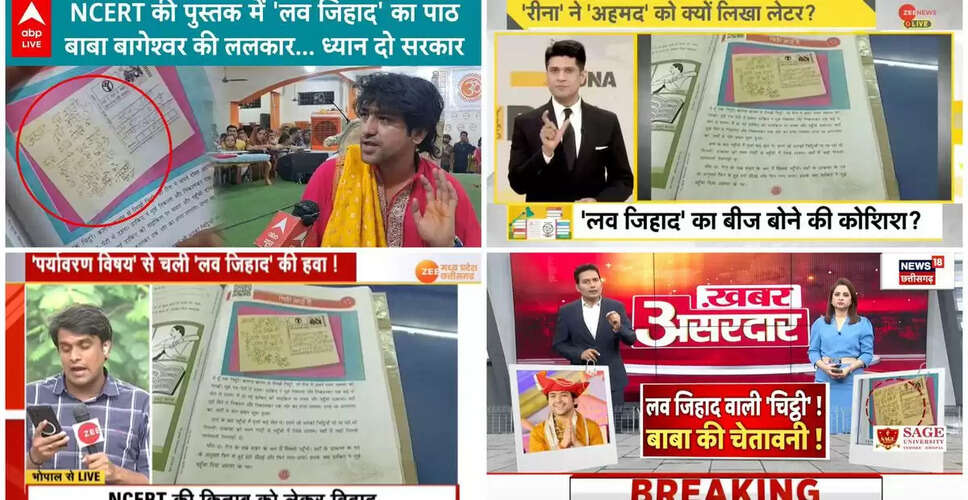
On Tuesday, the News Broadcasting and Digital Standards Authority mandated five news channels to remove eight programs that associated a National Council of Educational Research and Training (NCERT) textbook with a so-called 'love jihad' conspiracy.
The issue arose from the misrepresentation of a fictional letter in an NCERT Class 3 Environmental Studies chapter titled Chitti Aayi Hai. The letter, penned by a character named Reena to another character, Ahmed, was inaccurately portrayed by the channels as proof of a love jihad conspiracy, as per the complaint.
Love jihad refers to a controversial theory suggesting that Muslim men deceive Hindu women into romantic relationships to convert them to Islam. The Union home ministry has clarified to Parliament that Indian law does not recognize such a term.
The programs in question were broadcasted on various channels, including India TV, News18 MP/Chhattisgarh, Zee MP/Chhattisgarh, Zee News, and ABP News.
In its order issued on December 2, the regulatory authority emphasized that the mere depiction of a girl writing to a boy from a different religion does not warrant labeling it as love jihad.
Retired Justice AK Sikri, who chairs the regulatory body, remarked that India is constitutionally a secular nation. He stated, “Thus, presenting a particular chapter in an NCERT book in this manner by broadcasters constitutes a breach of the Code of Conduct.”
Allegations of Biased Reporting
Complainants Raise Concerns
The complainants, Indrajeet Ghorpade and Utkarsh Mishra, contended that despite previous reprimands for their coverage on love jihad, the channels opted to highlight a story that was “entirely subjective,” “highly polarizing,” and largely driven by groups seeking notoriety.
They claimed that the channels provided a platform for individuals promoting these assertions, with some anchors casually endorsing the narrative through suggestive tickers and commentary.
In a segment aired by News18 MP/Chhattisgarh, the coverage centered around remarks made by Dhirendra Shastri, the head priest of Bageshwar Dham, who asserted that Hindu women were at risk and that love jihad was a tactic to increase the Muslim population.
The complainants argued that the show reinforced Shastri’s claims without any critical analysis of whether these assertions were communal or divisive.
In broadcasts from Zee News and Zee Madhya Pradesh/Chhattisgarh, the complainants noted that while teachers were interviewed, the coverage implied that the textbook chapter was “suspicious.”
They pointed out that the reporter openly questioned the chapter's intent, suggesting that the inclusion of a letter from “Reena to Ahmed” was problematic.
Furthermore, they alleged that India TV showcased extreme reactions, including a person “blackening” the textbook, without challenging such conduct, thereby amplifying it.
The complainants highlighted a consistent pattern across all channels, noting a lack of critical engagement. They mentioned that while News18 MP/Chhattisgarh and ABP News did challenge Shastri’s claims, none of the channels sought to contact NCERT for clarification.
Channels Defend Their Coverage
Channels Respond to Allegations
During the hearings, the channels defended their broadcasts by stating they were merely reporting statements made by parents, political figures, or other public personalities.
News18 Madhya Pradesh/Chhattisgarh asserted that it aired Shastri's comments without endorsing or verifying them. They questioned whether the term love jihad could be deemed “unconstitutional or unparliamentary” and if there was any restriction on its usage.
India TV claimed its coverage focused on the protests and included NCERT’s response.
Zee and ABP News contended that the term love jihad was part of the original complaint from parents, and their reporting was based on the newsworthiness of the controversy.
Regulatory Authority's Decision
NBDSA's Ruling
The regulatory authority expressed disapproval regarding how the news story was handled.
Chairperson Sikri noted that a parent had raised concerns about the letter in the chapter, and the channels justified their coverage by claiming they were reporting on the complaint.
Sikri stated that limiting coverage to the complaint as news might not have led to objections. However, the broadcasters turned the complaint into a debate with a specific narrative, failing to interview other individuals or the 15 parents involved.
The NBDSA order also pointed out that some channels interviewed individuals with well-known views but did not include anyone with a differing perspective.
The regulator concluded that the structure of the shows demonstrated a clear lack of objectivity.
Consequently, the authority instructed the five channels to remove the videos from their websites, YouTube channels, and other platforms, requiring compliance reports within a week.