
Rediscovery of Rare Plant in Assam's Jatinga Hills

A Remarkable Botanical Find
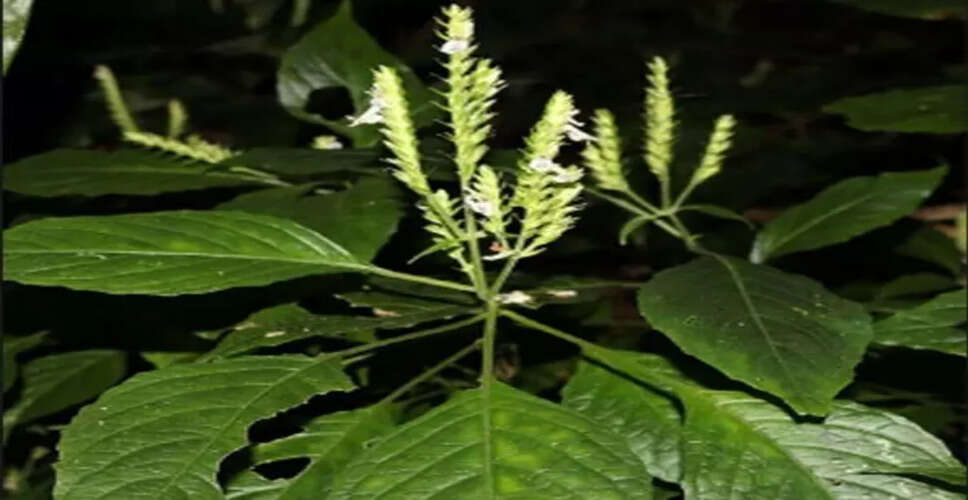
Rungia mastersii was first collected in 1845 by British botanist J.W. Masters. (AT Photo)
Silchar, July 27: After nearly 180 years of absence from botanical records, a rare flowering plant thought to be extinct has been found again in the Jatinga Hills of Assam's Dima Hasao district.
Researchers from Assam University's Department of Life Science and Bioinformatics stumbled upon Rungia mastersii thriving in moist, shaded rock crevices adjacent to a stream during their field studies in the region.
This plant showcases pale green to whitish flowers adorned with subtle purple markings. Its affinity for damp, shaded rock surfaces near streams indicates its reliance on a delicate and specific microhabitat.
The species was initially collected in 1845 by British botanist J.W. Masters from an undisclosed location along the Sundar River in Assam. Since that time, no living specimens have been reported in India or globally.
According to Professor Debjyoti Bhattacharyya, who co-led the research with Kankan Kumar Das, "For many botanists, this species was merely a name linked to an aging herbarium sheet. The Botanical Survey of India had only one preserved specimen, which added to the enigma surrounding the plant's identity and survival."
The findings of the duo, published in an international peer-reviewed botanical journal, have revived interest in this species.
In a press statement released on Monday, Professor Bhattacharyya noted that Rungia mastersii, part of the Acanthaceae family, is a shrubby herb that can grow between 60 cm and 110 cm tall. It was discovered at elevations ranging from about 900 to 1,250 meters above sea level.
Despite the excitement of this rediscovery, there are serious concerns regarding the plant's survival.
Currently, researchers have identified only one natural habitat that supports approximately 40 individual plants. Professor Bhattacharyya expressed that, "Such a limited population and narrow geographical range make the species susceptible to even minor disturbances, such as changes in stream flow, habitat degradation, landslides, deforestation, and human activities."
While the species is classified as "Not Evaluated" under the International Union for Conservation of Nature (IUCN) Red List, field observations suggest an urgent need for assessing its conservation status.
The researchers warn that without immediate protective measures, a plant that has remained hidden for nearly two centuries could vanish before its ecological importance is fully recognized.
This rediscovery offers researchers a unique chance to study the species in its natural environment and document its living characteristics.