
Record Voter Turnout in Assam Assembly Elections: A Historical Perspective

Historic Voter Participation in Assam
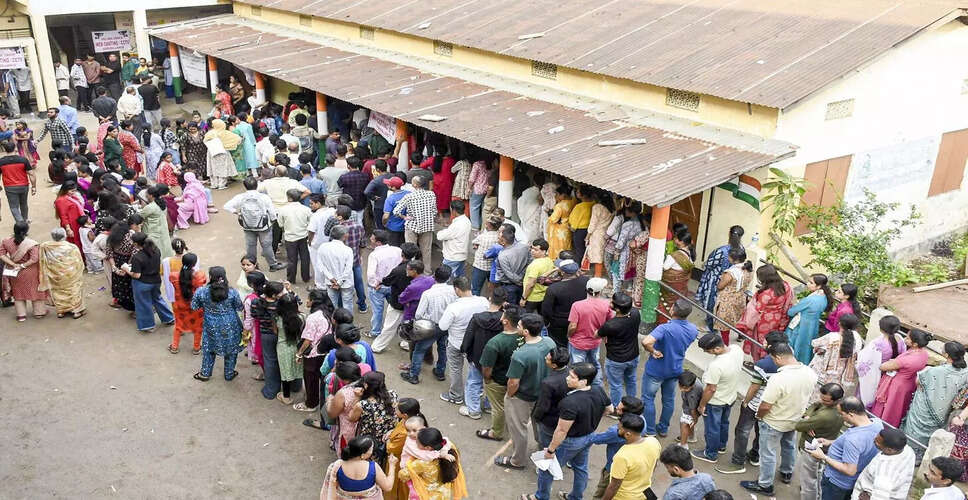
People wait in queues before casting their votes at a polling station in Guwahati. (Photo:PTI)
GUWAHATI, April 12: Assam has achieved its highest voter turnout in the recent Assembly elections held on April 9, with various stakeholders offering differing opinions on the implications of these numbers as the results await the unsealing of EVMs on May 4. The state's electorate has shown remarkable engagement in the democratic process over the years.
Analyzing the data reveals that there is no definitive correlation between voter turnout and election outcomes.
Since the inaugural Assembly elections in 1951, voter participation has seen fluctuations over the decades, generally trending upwards.
From the mid-1980s onward, turnout rates have consistently exceeded 70 percent, surpassing 80 percent since 2016.
The initial voter turnout was recorded at 47.54 percent in 1951.
This figure rose to 51.37 percent in the 1957 elections, only to dip slightly to 51.05 percent in 1962.
In 1967, turnout increased to 61.83 percent, but fell again to 60.85 percent in 1972.
The post-Emergency elections of 1978 saw a significant rise to 66.86 percent, marking a shift in power dynamics in Dispur.
However, the 1983 elections, marred by the Assam Agitation and widespread boycotts, recorded a dismal turnout of just 32.74 percent, the lowest in history.
Following the historic Assam Accord in 1985, voter participation surged to an impressive 79.21 percent, leading to the formation of the first AGP government.
In 1991, participation dipped to 74.67 percent as the Congress regained control.
Turnout rose again to 78.92 percent in 1996 when the AGP won for a second time.
The rates remained stable at 75.05 percent in 2001, 75.72 percent in 2006, and 76.04 percent in 2011, during Congress's three consecutive victories.
In 2016, turnout soared to 84.67 percent, enabling the BJP-led NDA to take power for the first time.
In 2021, it slightly decreased to 82.42 percent, but the recent elections saw an unprecedented turnout of 85.92 percent.
Assam's political landscape has experienced significant shifts during elections with high turnout, such as in 1978, 1985, and 2016, while lower participation in 1991 and 2001 also influenced outcomes.
Historically, higher turnout in other states was often linked to anti-incumbency, a trend that has evolved in recent years.
Bihar's 2025 elections recorded its highest turnout, resulting in the ruling NDA's return to power, while Maharashtra saw its best turnout in 30 years in 2024, with the incumbent government retaining its position.
In Assam, constituencies with significant Muslim populations have typically shown higher turnout rates, but this election saw even those with larger indigenous communities participating actively. The Kamrup Metro district reported impressive turnout figures, breaking the trend of urban voter apathy.
Polling exceeded 96 percent in Birsing Jarua and Jaleswar LACs, with over 95 percent in Dalgaon, Mankachar, and Chenga. Other notable areas like Tihu, Rongonadi, Rangia (each over 87 percent), and Bongaigaon (over 90 percent) also showed strong participation.
Additionally, the Special Revision (SR) conducted in Assam led to a reduction of 2.43 lakh names from the electoral roll, shrinking the electorate by nearly one percent, a factor to consider when analyzing the turnout figures for 2026.
The high turnout also indicates effective mobilization efforts by political parties on Election Day.
Moreover, the mild weather on April 9, with light rain in several areas and comfortable temperatures, likely contributed to the increased voter participation.
In discussions with a Media House, senior political leaders shared their insights on the record turnout and its potential impact on the election results.
Kishore Upadhyay, the state BJP chief spokesperson, attributed the high turnout to increased participation from indigenous communities, public satisfaction with the current government's performance, and a desire for continuity.
Conversely, Mehdi Alam Bora, vice president of the Assam Pradesh Congress Committee (APCC), suggested that the turnout reflects significant anti-incumbency sentiment, particularly among younger voters aged 18-39, and a growing discontent with divisive politics.
Haidor Hussain Bora, general secretary of AIUDF, expressed confidence that the high turnout in minority areas would benefit their party led by Badruddin Ajmal.