
Raseedi Ticket: A Tribute to Amrita Pritam's Life and Legacy at National Theatre Festival 2026

Celebrating Amrita Pritam's Journey Through Theatre
Munish Sood
Satohal (Mandi)
The five-day National Theatre Festival 2026 concluded in Satohal, Mandi, with a poignant performance of Raseedi Ticket, which vividly depicted the memories, struggles, and unexpressed love of the renowned author Amrita Pritam.
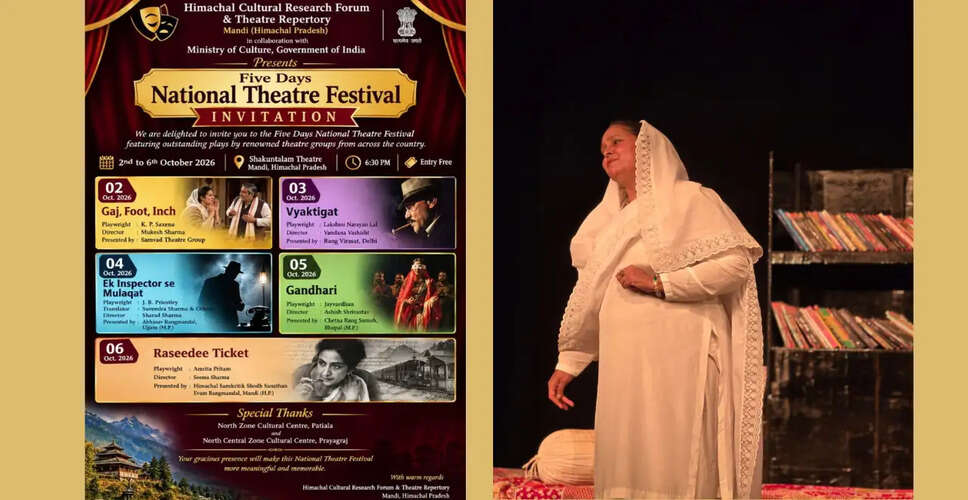
This festival, organized by the Himachal Cultural Research Forum and Theatre Repertory, Mandi, in partnership with the Ministry of Culture, Government of India, took place from October 2 to 6 at the Shakuntalam Theatre. It featured various theatre groups and artists from across the nation, offering a rich array of performances that included social dramas, literary adaptations, mythological tales, and explorations of human relationships, all accessible to the public at no cost.
The festival kicked off on October 2 with Gaj, Foot, Inch, a play by the esteemed playwright K.P. Saxena, directed by Mukesh Sharma and performed by the Samvad Theatre Group. The following day, the audience enjoyed Ek Inspector Se Mulakat, an adaptation of J.B. Priestley’s An Inspector Calls, reimagined by Surendra Sharma and directed by Sharad Sharma, presented by Abhinav Rangmandal from Ujjain.
On October 4, Rang Virasat from Delhi showcased Vyaktigat, a work by Lakshmi Narayan Lal directed by Vandana Vashishth. The festival then explored Indian mythology with Gandhari on October 5, written by Jayvardhan and directed by Ashish Shrivastava, performed by Chetna Rang Samuh from Bhopal.
The festival culminated on October 6 with Raseedi Ticket, based on Amrita Pritam's acclaimed literary piece. This production, directed by Seema Sharma, not only highlighted the essence of Pritam's life but also featured her in a challenging solo role.
Amrita Pritam’s autobiography, Raseedi Ticket, transcends a mere recounting of her life; it serves as a profound self-exploration of a woman striving for her voice amidst societal norms and personal challenges. It begins with her childhood memories and traverses through themes of love, separation, struggle, literature, and self-empowerment, presenting her life journey with striking honesty.
The stage adaptation skillfully wove together various aspects of Amrita’s existence, showcasing her identities as a poet, a woman facing life's adversities, a passionate lover, and a writer challenging societal expectations.
The performance also delved into Amrita’s complex and often unvoiced relationship with Sahir Ludhianvi, where silence conveyed more than words. Her feelings for Sahir, the memories expressed in her poetry, and the enduring sorrow of unfulfilled love added layers of emotional depth to the portrayal.
Another pivotal chapter in her life was the arrival of Imroz, depicted as a love that embraced freedom and individuality rather than possession.
Raseedi Ticket encapsulates the defining moments of Amrita’s life, which she transformed into literary art. Her writing resonates universally, turning personal anguish and love into a legacy that continues to touch readers across generations.
Seema Sharma’s solo performance was particularly noteworthy, as she not only embodied Amrita but also immersed herself in the emotional landscape of the writer. At times, she appeared as Amrita lost in reflection, at others as a woman yearning for love, and as a writer confronting societal norms, ultimately portraying a woman reflecting on her life from a mature perspective.
Her performance was characterized by a blend of dialogue, silence, expressions, and body language, creating an intimate representation of Amrita Pritam.
Additionally, the festival highlighted Mandi's potential as a hub for serious theatre and cultural dialogue. With productions from Delhi, Ujjain, and Bhopal, alongside local talent, the event fostered a vibrant exchange of theatrical traditions, literary works, and artistic viewpoints for the Himachali audience.