
Rajnath Singh Inaugurates Key Infrastructure Projects in Ladakh
Significant Developments in Border Infrastructure
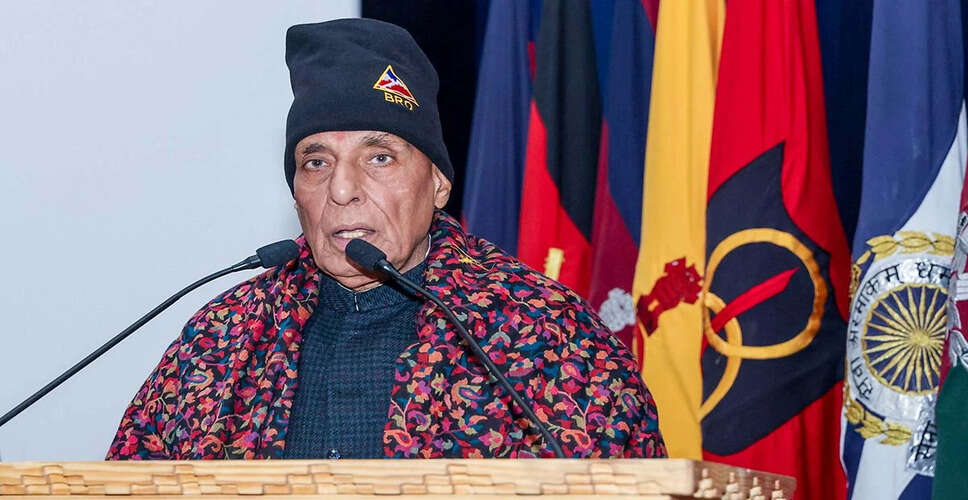
On Sunday, Defence Minister Rajnath Singh inaugurated 125 crucial infrastructure projects by the Border Roads Organization (BRO) in Ladakh and other border regions. Among these projects is the strategically vital Shyok Tunnel located on the Dubuk-Shyok-Daulat Beg Oldi (DS-DBO) road in eastern Ladakh. Additionally, he virtually inaugurated the Galwan War Memorial to honor Indian soldiers who lost their lives during the clash with Chinese troops in the Galwan Valley in 2020.
Engineering Marvel in Challenging Terrain
The 920-meter-long cut-and-cover tunnel has been constructed in an area where weather, geography, and altitude pose significant challenges to construction. Heavy snowfall, avalanches, and extreme temperatures often isolate this region for extended periods each year. This tunnel is expected to revolutionize the Indian Army's rapid deployment, redeployment, and logistical support around the Line of Actual Control (LAC). It will reduce reliance on air maintenance, ensuring seamless movement of troops, fuel, weapons, and machinery even during winter.
Strengthening National Security and Development
The Defence Minister described this project as a testament to engineering in one of the world's toughest terrains, emphasizing that it will not only enhance strategic security but also accelerate civilian life and basic development in border areas. The 125 projects include 28 roads, 93 bridges, and four other initiatives, all completed at a total cost of ₹5,000 crores, spanning Ladakh, Jammu and Kashmir, and seven other states. According to the Defence Ministry, these projects will strengthen last-mile connectivity to remote villages and forward military outposts.
Impact of Infrastructure on Military Operations
During his address, Rajnath Singh noted that robust border infrastructure played a decisive role in the success of recent military operations like Operation Sindoor. Improved connectivity facilitated timely logistical support, which was crucial for the successful execution of missions. He stated that roads, tunnels, smart fencing, integrated command centers, and modern surveillance systems are now the foundation of India's security, with no component being isolated from security.
BRO's Growing Role and Future Goals
Lieutenant General Raghu Srinivasan, Director General of BRO, mentioned that the organization has become the preferred agency for key departments such as the Home Ministry, External Affairs Ministry, and Ministry of Road Transport. In the fiscal year 2024-25, BRO aims to complete a record ₹16,690 crores worth of work, with a target of ₹18,700 crores set for the next fiscal year.
Geopolitical Significance of the Shyok Tunnel
India's northern borders, particularly eastern Ladakh, have been at the center of changing geopolitical equations over the past four years. The tensions between India and China from 2020 to 2024, along with multiple rounds of military talks and phased disengagement, have highlighted that modern warfare is fought not only with the bravery of soldiers but also through strong infrastructure and connectivity. In this context, the Shyok Tunnel and the other 124 BRO projects send a strategic message that India stands prepared, confident, and technologically capable at its borders.
Broader Implications for Local Communities
The Shyok Tunnel holds strategic importance for several reasons. It ensures all-weather connectivity, allowing military convoys to operate uninterrupted even during winter when the area is covered in snow. This will facilitate rapid troop deployment, especially in sensitive regions where every minute counts. Furthermore, it will reduce logistical costs, as air maintenance is expensive and weather-dependent. The tunnel will alleviate many of these challenges.
A Comprehensive National Strategy
These projects are not solely for the military; they also open new opportunities for local communities, tourism, and economic activities. When people in border areas feel connected to development, it weakens external influences. This adds a social dimension to security, emphasizing that trust and development are crucial components of border security, alongside weapons. Thus, the new BRO projects are not just roads and bridges; they are part of a broader national strategy that strengthens, stabilizes, and modernizes India’s northern borders, preparing it for the challenges of the 21st century.