
Railway Board Mandates Brake Tests Following Kolkata-Sairang Express Derailment
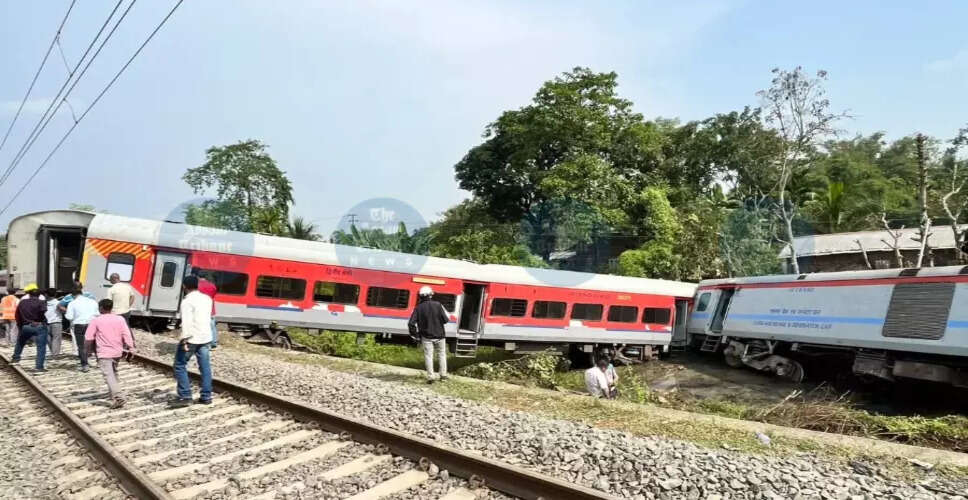

Overview of the Incident
The coaches of the derailed train at Digaru. (Image Source)
New Delhi, Nov 13: In response to the derailment of the Kolkata-Sairang Express near Digaru in Guwahati, the Railway Board has instructed all zonal railways to ensure that the crew performs braking tests after taking charge of a train.
Officials indicated that this directive emphasizes existing protocols for brake tests, which may not have been adhered to in the incident involving the Kolkata-Sairang Express.
Additionally, the board has mandated a safety initiative from November 12 to 18 to verify that locomotive crews carry out brake feel and brake power assessments.
“Any irregularities identified should be compiled and sent to the Railway Board by November 20, 2026,” the board stated in a directive issued on November 11 to all zonal railways.
Preliminary Investigation Findings
A preliminary investigation into the derailment at Digaru has indicated a failure in the train's primary braking system.
The six-member investigation team discovered that the BP angle cock, a crucial part of the braking system, was isolated in the locomotive.
The report does not clarify who caused the braking system to malfunction or if the train crew neglected safety protocols that required them to verify its functionality before operating the train.
Sources revealed that when the crew assumed control of the train in Guwahati, the BP angle cock had been isolated by station personnel, allegedly due to a communication error.
The train typically stopped at Guwahati, where its electric locomotive was regularly swapped for a diesel one. To facilitate this, station staff would isolate the BP angle cock.
“However, in recent days, following the electrification of the route, the practice of changing locomotives was halted, and the electric locomotive began operating the train beyond Guwahati,” an official explained.
The staff member responsible for isolating the angle cock was on leave when the locomotive interchange was stopped.
“Upon returning to duty on November 11, he isolated the angle cock as part of his routine, seemingly unaware that the same electric locomotive would continue its journey beyond Guwahati,” the official noted.
“To complicate matters, the train crew either neglected to perform the required braking tests or, if they did, relied on the alternative regenerative braking system alongside the main braking system, A-9,” he added.
It is believed that the crew attempted to engage the main braking system while trying to halt the train near the loop line, only to find it non-functional, leading to the derailment, the official stated.
The Railway Board's directive reiterates that the loco pilot is accountable for monitoring the efficiency of the train's brakes and brake power.
“The loco pilot must assess the effectiveness of the train's brakes and brake power,” the board emphasized.