
Rahul Gandhi Urges PM Modi to Address Iran's Supreme Leader's Assassination
Call for Clarity on International Relations
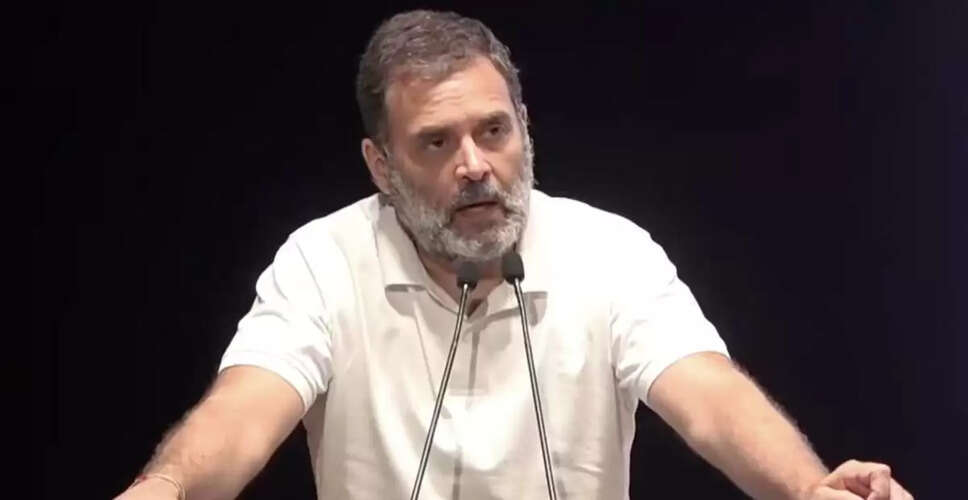
On Tuesday, Congress leader Rahul Gandhi emphasized the need for Prime Minister Narendra Modi to publicly address the assassination of Iran’s Supreme Leader, Ayatollah Ali Khamenei, which occurred on March 1 during a coordinated military operation by the United States and Israel.
In a post on social media, Gandhi pointed out that the rising tensions among the US, Israel, and Iran are pushing an already unstable region closer to broader conflict, affecting millions, including many Indians.
He stated, “While security issues are valid, actions that breach sovereignty will only exacerbate the crisis.” Gandhi condemned both the unilateral strikes on Iran and Iran's retaliatory actions against other nations in West Asia.
“India must take a clear moral stance,” he asserted. “We need the courage to advocate for international law and the protection of human lives.”
Gandhi warned that India's current silence could undermine its global reputation.
“PM Modi must take a stand,” he urged in his social media message. “Does he endorse the assassination of a head of state as a means to shape the global order?”
Similarly, Congress leader Sonia Gandhi remarked on Monday that the government's lack of response to Khamenei's assassination is not a neutral position but rather an abdication of responsibility.
In her article for a prominent publication, she described the killing of a sitting leader amid ongoing diplomatic efforts as a significant disruption in modern international relations.
“Beyond the shock of this incident, what is equally concerning is New Delhi’s silence,” she noted.
Sonia Gandhi pointed out that Modi had initially condemned Iran’s retaliatory strike on the UAE without addressing the events leading up to it, later expressing mere concern and calling for dialogue, which she argued had already been in progress before the unprovoked attacks.
“In this case, silence is not a neutral stance,” she stated, adding that the targeted killing, executed without a formal declaration of war, undermines the principles of sovereignty and international law as outlined in the United Nations Charter.
The conflict escalated on Saturday when Israel and the US initiated a joint operation against the Iranian regime, claiming its actions posed an “existential threat to Israel.” Israel has asserted that Iran is closer than ever to acquiring a nuclear weapon, which could disrupt the regional security landscape.
Iran has consistently maintained that its nuclear program is intended for peaceful purposes.
The assassination of Khamenei, who has held power over all government branches and the military since 1989, has further intensified an already precarious situation in the region.
New Delhi has yet to issue any official statement following Khamenei's death.
However, on Sunday, Modi expressed condolences for the fatalities in the UAE during a conversation with President Sheikh Mohamed bin Zayed Al Nahyan, thanking him for his support of the Indian community in the UAE. Modi stated, “We advocate for de-escalation, regional peace, security, and stability.”
On Monday, Modi revealed that he had spoken with Netanyahu the previous day to discuss the ongoing situation in West Asia, emphasizing India’s concerns regarding recent developments and prioritizing civilian safety. “India reiterates the need for an immediate halt to hostilities,” Modi remarked about the call.