
Protests Erupt in Delhi as Cockroach Janta Party Demands Education Reforms
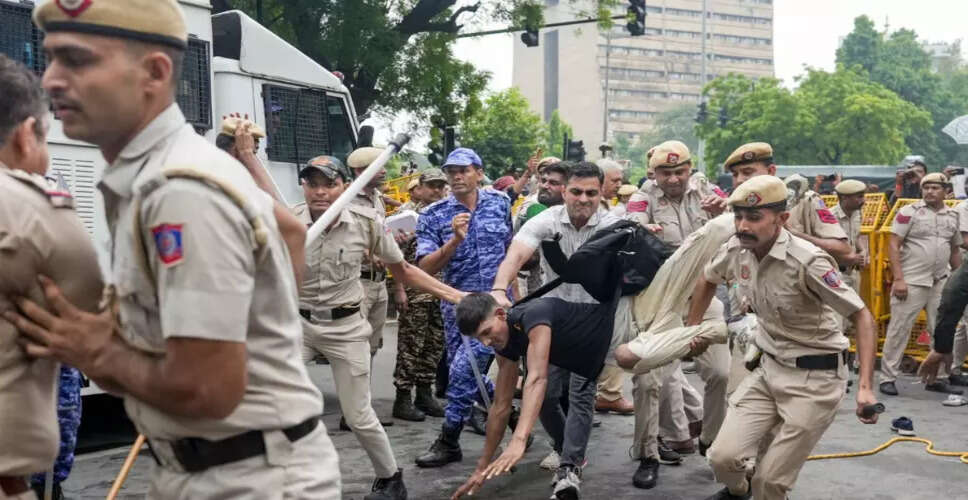

Tensions Rise During CJP's March in New Delhi
Delhi Police detaining protesters attempting to push through security barricades in a bid to reach Jantar Mantar to join the CJP's march on Monday (Photo: PTI)
New Delhi, July 20: On Monday, the central government initiated discussions with the Cockroach Janta Party (CJP) as their "Sansad Chalo" march led to chaotic scenes in central Delhi. Thousands of demonstrators attempted to advance towards Parliament, resulting in clashes with law enforcement and heightened security measures throughout the capital.
This incident coincided with the commencement of the Monsoon Session of Parliament, during which the CJP escalated its campaign regarding alleged discrepancies in competitive exams, calling for accountability, thorough reforms in the examination process, and the resignation of Union Education Minister Dharmendra Pradhan.
CJP spokesperson Saurav Das announced on social media that the government had reached out for dialogue that morning, inviting representatives for discussions.
"It's 11:52 AM. Ashutosh Ranka and I, representing the Cockroach Janta Party, are en route to meet JP Nadda. The government contacted us for talks earlier today. Our demands are straightforward. The youth have gathered in large numbers," Das stated.
However, there was no official confirmation from the government regarding the meeting or the discussions.
Despite heavy rain and strict security measures, thousands of protesters gathered near Parliament Street and Jantar Mantar. As they attempted to march towards Parliament, police intervened with multiple barricades set up in the high-security area.
Sources indicated that around 11:25 AM, protesters tried to breach the barricades, leading to scuffles that resulted in minor injuries to both demonstrators and police personnel. Approximately 10 to 15 protesters were taken into custody.
In response to groups of protesters allegedly trying to breach security lines, security forces deployed tear gas shells near Shastri Bhawan.
Videos from the protest site depicted police using batons after demonstrators attempted to push through barricades. Nevertheless, New Delhi's Deputy Commissioner of Police, Sachin Sharma, asserted that police did not use force against the protesters.
Authorities had previously denied permission for the march and enforced prohibitory orders under Section 163 of the Bharatiya Nagarik Suraksha Sanhita, warning that any attempt to approach Parliament would not be tolerated.
Security measures were significantly intensified across Delhi, especially at border entry points and other sensitive areas in New Delhi. Police conducted thorough vehicle inspections and deployed additional personnel to prevent any disturbances.
The increased security also caused disruptions in daily commuting across the city.
The Delhi Metro Rail Corporation (DMRC) temporarily closed several metro stations, including Janpath, Patel Chowk, Rajiv Chowk, Central Secretariat, and Seva Teerth, leading to significant congestion and confusion among commuters.
Despite the restrictions, protesters continued to arrive at Jantar Mantar throughout the morning. The CJP shared images and videos on social media, asserting that large crowds had gathered despite the rain and security clampdown.
"Heavy rains and massive security, but nothing will stop the cockroaches today," the organization posted.
In a separate development, three activists from the All India Students' Association (AISA) — Neha, Manish, and Aameen — concluded their 23-day hunger strike following an appeal from a delegation of parliamentarians and civil society representatives. The delegation assured them that their demands would be addressed during the Monsoon Session and encouraged them to shift their protest from a hunger strike to broader campaigns.
Activist Sonam Wangchuk, however, stated that he would continue his fast beyond the "Sansad Chalo" march unless the government acknowledged its alleged failures in the education system or political leaders assured him that the issue would be discussed in Parliament.
He also claimed to be under "illegal detention" at Safdarjung Hospital, alleging that his movement, speech, and communication were being restricted.