
Prime Minister Modi Remembers Jawaharlal Nehru on His Death Anniversary

Tribute to a Visionary Leader
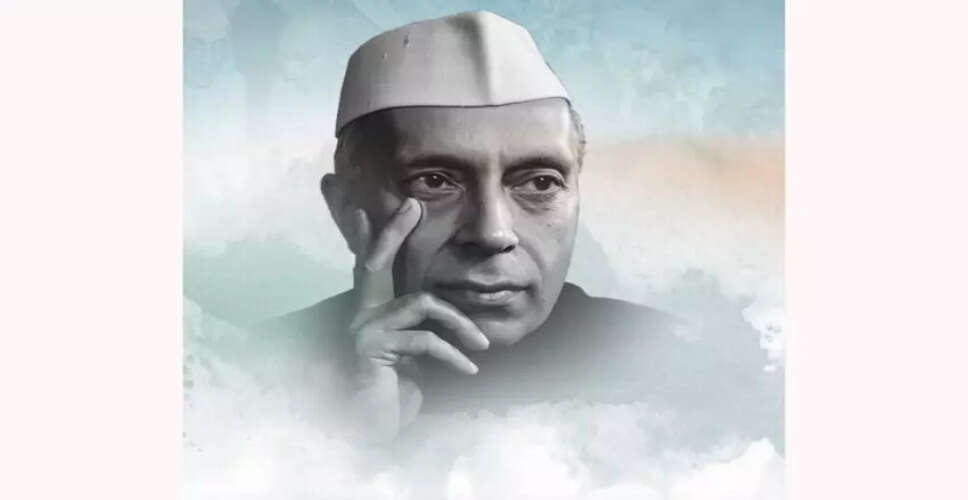
A file image of India's first Prime Minister Pandit Jawaharlal Nehru (Photo: IANS)
New Delhi, May 27: On Wednesday, Prime Minister Narendra Modi honored the memory of former Prime Minister Pandit Jawaharlal Nehru, marking the anniversary of his passing.
Modi expressed his tribute via a post on social media platform 'X', stating, "Paying homage to former Prime Minister Pandit Jawaharlal Nehru on his death anniversary."
Nehru, born in Allahabad on November 14, 1889, received his initial education at home with private tutors. At the age of 15, he moved to England for further studies, first attending Harrow and then Cambridge University, where he earned a degree in Natural Sciences. He later qualified as a barrister from the Inner Temple in London.
Returning to India in 1912, Nehru quickly became involved in the political landscape. Even as a student, he was passionate about global movements against colonial rule, particularly inspired by the Sinn Féin movement in Ireland, which fueled his dedication to India's independence.
In 1912, he participated as a delegate in the Bankipore session of the Congress. By 1919, he had taken on the role of Secretary of the Home Rule League in Allahabad. His first encounter with Mahatma Gandhi occurred in 1916, and Gandhi's philosophies significantly influenced him. In 1920, Nehru organized the inaugural Kisan March in Pratapgarh, Uttar Pradesh, and was imprisoned twice during the Non-Cooperation Movement from 1920 to 1922.
In September 1923, he became the General Secretary of the All India Congress Committee. A few years later, in 1926, he traveled across Europe and the Soviet Union, representing the Indian National Congress at the Congress of Oppressed Nationalities in Brussels, Belgium. He also attended the tenth anniversary celebrations of the October Socialist Revolution in Moscow in 1927.
At the Madras Congress in 1926, Nehru was a strong advocate for India's complete independence. In 1928, he was injured during a police charge while protesting against the Simon Commission in Lucknow. That same year, he signed the Nehru Report on constitutional reforms, which was prepared under the guidance of his father, Motilal Nehru, and founded the Independence for India League, serving as its General Secretary.
In 1929, Nehru was elected President of the Lahore Session of the Indian National Congress, where the Congress officially declared complete independence as its goal. Between 1930 and 1935, he faced multiple imprisonments for his involvement in the Salt Satyagraha and other freedom movements. While incarcerated in Almora Jail, he completed his autobiography on February 14, 1935. After his release, he visited Switzerland to see his ailing wife and later traveled to London in 1936. In 1938, he visited Spain during its Civil War and traveled to China shortly before World War II began.
Nehru was arrested on October 31, 1940, for his participation in the Satyagraha against India's forced involvement in World War II, but was released in December 1941 along with other leaders. On August 7, 1942, he introduced the historic Quit India Resolution at the All India Congress Committee session in Bombay, leading to his arrest the following day, marking his longest imprisonment. Throughout the freedom struggle, he was jailed nine times.
After his release in January 1945, Nehru played a crucial role in organizing the legal defense for officers of the Indian National Army accused of treason. In 1946, he toured Southeast Asia and was elected Congress President for the fourth time, continuing to serve in this capacity for several terms until 1954.
Pandit Jawaharlal Nehru passed away on May 27, 1964, due to a heart attack, with the announcement made in the Lok Sabha later that day. His birthday, November 14, is celebrated annually in India as Children’s Day, reflecting his deep affection for children.