
Prime Minister Modi Leads 11th Governing Council Meeting of NITI Aayog
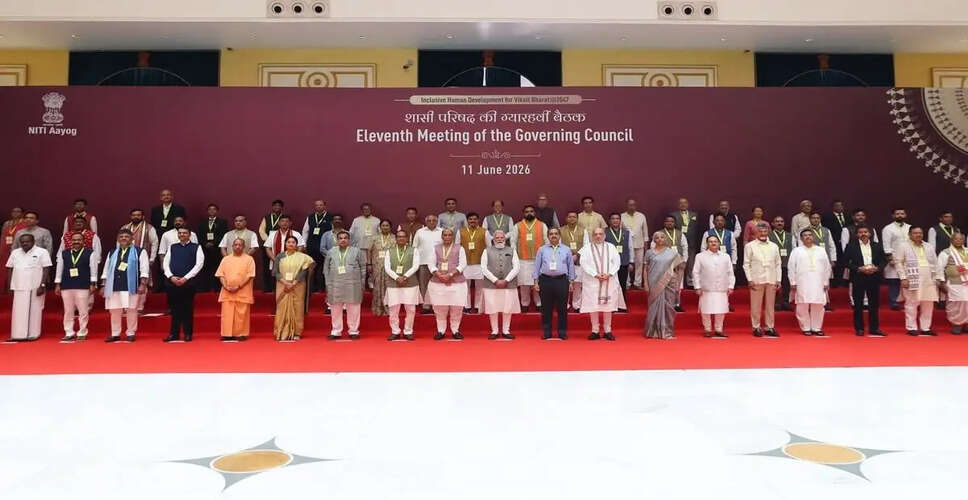

Overview of the Governing Council Meeting
On Thursday, Prime Minister Narendra Modi presided over the 11th Governing Council meeting of NITI Aayog at the Rashtrapati Bhavan Cultural Centre in New Delhi. This significant gathering included Chief Ministers from various states and Union Territories, along with Lieutenant Governors and Administrators. Central Ministers participated as ex-officio members, while the Vice Chairman, members, and Chief Executive Officer (CEO) of NITI Aayog were also present.
Key Attendees and Discussions
Union Home Minister Amit Shah and Defence Minister Rajnath Singh were among the attendees. Several Chief Ministers participated, including Yogi Adityanath from Uttar Pradesh, Himanta Biswa Sarma from Assam, Samrat Chaudhary from Bihar, Rekha Gupta from Delhi, and Nayab Singh Saini from Haryana. Newly elected leaders such as Suvendu Adhikari from West Bengal, C. Joseph Vijay from Tamil Nadu, D.K. Shivakumar from Karnataka, and V.D. Satheesan from Kerala were also in attendance.
Theme and Focus Areas
According to a statement from NITI Aayog, the theme for this year is 'Inclusive Human Development for a Developed India by 2047.' This theme emphasizes the welfare and development of all citizens, regardless of age, region, gender, or socio-economic background. Additionally, PM Modi will discuss measures to promote entrepreneurship, enhance skills, and create sustainable employment opportunities across the nation.
Framework for Inclusive Human Development
The 'Inclusive Human Development Framework' is based on four main pillars: essential human capital and skills for the future; productive employment, entrepreneurship, and decentralized development; health, nutrition, and well-being; and equality and respect for all. The discussions will primarily focus on developing an 'Implementation Roadmap' that utilizes key tools such as governance, Digital Public Infrastructure (DPI), convergence, partnerships, and data-driven systems.
Goals and Accountability
A systematic approach will be adopted to track short, medium, and long-term outcomes, ensuring accountability and measuring impact. A particular emphasis will be placed on aligning state visions with the national vision for inclusive human development, fostering a unified and collaborative approach for equitable and sustainable growth.