
Prime Minister Modi Highlights Development in Delhi Post BJP Government Formation
Modi's Vision for Delhi's Growth
On Sunday, Prime Minister Narendra Modi emphasized that since the establishment of the BJP government in the national capital a year ago, the pace of development in Delhi has significantly accelerated. He criticized the Aam Aadmi Party (AAP) for its governance, claiming that their excuses led to stagnation, causing projects to 'die in files.'
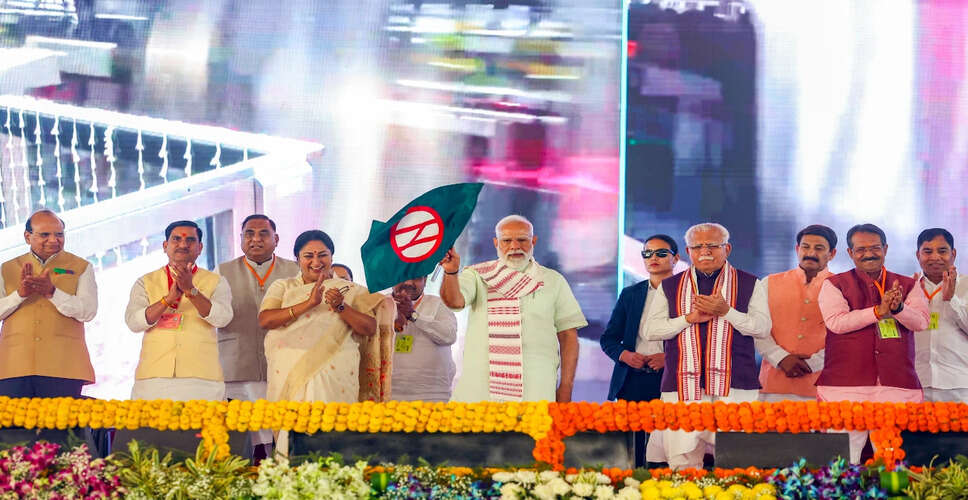
While inaugurating projects worth ₹33,500 crores, including two new metro corridors, Modi addressed a gathering at Burari Maidan, stating that Delhi is not just the capital of India but also a symbol of the nation's identity and energy.
He recalled a time when Delhi's inefficient transport system faced frequent criticism, noting, 'Traveling from one part of the city to another took hours, and women often had to wait long at bus stops hoping to catch a bus or auto-rickshaw. However, the situation in Delhi is changing rapidly.'
Modi mentioned that just days ago, the city was connected to western Uttar Pradesh via the 'Namo Bharat' train, making travel between the two regions much easier.
With the launch of the fourth phase of the metro, the Delhi Metro network has now expanded to over 375 kilometers, enhancing connectivity and convenience for residents.
He remarked, 'Whenever the world thinks of India, the image of Delhi often comes to mind... Delhi is not only the capital but also a representation of India's identity and energy.' He added that the development of Delhi is linked to the image of the entire country.
Modi congratulated the citizens of Delhi for the continuous stream of development resulting from the hope and determination they showed a year ago when forming the BJP government.
He harshly criticized the previous AAP government, labeling it a 'disaster government' that halted all development for a decade, stating, 'Their approach was to do less work and make more excuses. Today, Delhi has become a model of development—excuses have ceased, and work has commenced.'
Inauguration of Key Projects
He pointed out that previously, projects would languish in files, but now they are being implemented on the ground. Modi inaugurated and laid the foundation for projects worth ₹15,200 crores under the General Pool Residential Accommodation (GPRA) redevelopment scheme.
Accompanied by the Union Minister for Housing and Urban Affairs, Modi visited the GPRA Type-5 quarters in Sarojini Nagar and handed over keys to female beneficiaries, engaging in conversations with some of the women workers.
He inaugurated the 12.3-kilometer Majlis Park-Maujpur-Babarpur corridor of the Pink Line and the 9.9-kilometer Dipali Chowk-Majlis Park corridor of the Magenta Line. These corridors will benefit several areas in Delhi, including Burari, Jagatpur-Wazirabad, Khajuri Khas, Bhajanpura, Yamuna Vihar, Madhuban Chowk, Haiderpur Badli Mor, Bhalswa, and Majlis Park.
Additionally, Modi laid the foundation for three new Delhi Metro corridors under the Phase 5-A expansion plan, which will span approximately 16.1 kilometers. This includes the Ramakrishna Ashram Marg-Indraprastha corridor, the Aerocity-Indira Gandhi International Airport Terminal-1 corridor, and the Tughlakabad-Kalindi Kunj corridor, improving connectivity between central Delhi, South Delhi, Noida, and the airport.
He stated that the scope of these projects is extensive, encompassing the expansion of the metro network and the establishment of modern residential complexes for thousands of government employees.
A Year of Progress
Modi remarked, 'The people of Delhi formed the 'double-engine' government here a year ago with new hope and determination, and the results are evident in these development works today.'
He explained that under the 'double-engine' governance model, every transport facility in the national capital is being systematically upgraded to ensure clean, comfortable, and modern travel for millions of citizens who rely on bus services daily.
The Prime Minister noted that over 4,000 electric buses provided by the central government are already operational, and in the past year alone, 1,800 new buses have been introduced, including hundreds of 'Devi buses' designed to enhance connectivity in Delhi's colonies and neighborhoods.