
Political Turmoil in West Bengal: President Murmu's Remarks Ignite Tensions with TMC
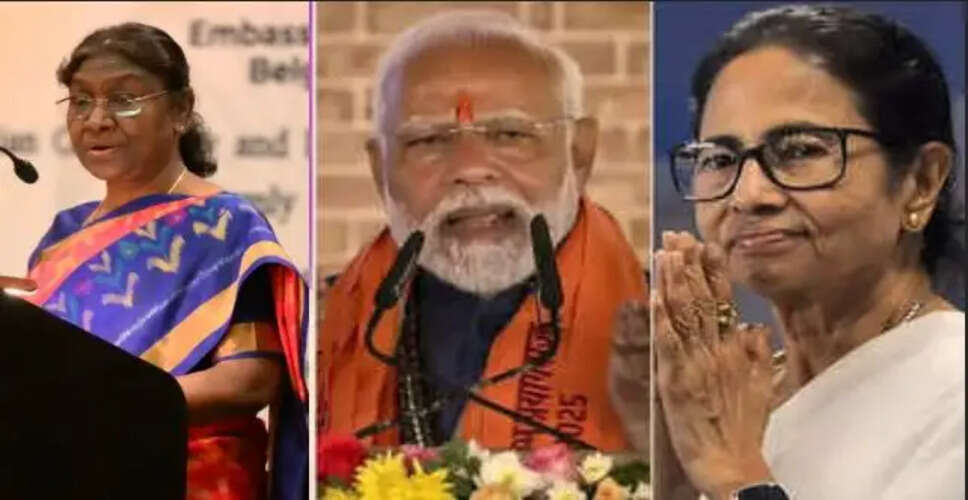
Political Tensions Rise in West Bengal
Kolkata/New Delhi: A heated political clash unfolded in West Bengal on Saturday as President Droupadi Murmu highlighted the lack of development for tribal communities in northern Bengal. This statement provoked a strong backlash from Chief Minister Mamata Banerjee, while Prime Minister Narendra Modi accused the Trinamool Congress (TMC) of disrespecting the President.
The situation quickly escalated into a three-way political dispute involving the President, Banerjee, and Modi, intensifying the competition for tribal support between the ruling TMC and the BJP ahead of the upcoming assembly elections.
Speaking at the 9th International Santal Conference near Bagdogra, Murmu expressed her concerns that the Santals and other tribal groups in the region had not fully benefited from development initiatives, prompting a fierce response from the TMC.
Banerjee claimed that the President was speaking 'on the advice of the BJP' and questioned her silence regarding alleged violence against tribal communities in states like Manipur and Chhattisgarh.
Modi joined the fray, accusing the West Bengal government of insulting the President during her visit, labeling the incident as 'shameful and unprecedented' and asserting that the TMC had 'crossed all limits'.
In her speech, Murmu stated, 'I do not believe that Santals and other adivasis in this area are progressing as they should. The benefits of development have not reached you adequately.'
Later, while addressing reporters at Phasidewa, where the event was held, Murmu expressed disappointment over the low attendance, questioning the decision to move the venue from Bidhannagar to a location near Bagdogra airport, which she felt hindered tribal participation.
Murmu also pointed out the absence of Banerjee and other state ministers during her visit, stating, 'Typically, when the President visits, the Chief Minister should be there to welcome her, along with other ministers. But she did not attend.'
This prompted a sharp political rebuttal from Banerjee, who accused the BJP of exploiting the President's office to undermine the state government ahead of elections.
Banerjee escalated her confrontation with constitutional authorities, claiming that politics was being played 'using the Hon'ble President on the advice of the BJP' and alleging that 'no work has been done for tribals'.
'I feel ashamed to even say this. We respect the Hon'ble President. However, she too has been sent to play politics... I apologize, Madam. I hold you in high regard, but you are being influenced by BJP's policies and directives,' she stated during an anti-SIR protest in Kolkata.
The Chief Minister also refuted claims that the state government did not send representatives to the event, noting that Siliguri Mayor Gautam Deb was present and that the program was not organized by the Bengal government.
Linking the controversy to the ongoing political struggle over the SIR of electoral rolls, she alleged that tribal voters were being targeted during the revision process.
'Do you (President Murmu) know how many tribals were removed from the voter list in Bengal? Please investigate this and speak out against it,' she urged.
Banerjee further questioned the BJP's record on tribal welfare in states under its governance, citing alleged violence against tribal communities in Manipur, Rajasthan, Maharashtra, Madhya Pradesh, and Chhattisgarh.
'When tribals were suffering in Manipur, why were you silent? Why is Bengal being singled out?' she asked.
The controversy elicited a strong response from Modi, who emphasized that the office of the President transcends politics and should always be respected. He expressed hope that the West Bengal government and the TMC would act with better judgment.
'This is shameful and unprecedented. Anyone who values democracy and the empowerment of tribal communities is disheartened,' Modi remarked in a post on X.
He noted that the pain expressed by the President, who belongs to a tribal community, has caused significant sadness among the Indian populace.
'The TMC Government of West Bengal has truly crossed all limits. Their administration is responsible for this insult to the President,' he stated.
Modi lamented that a topic as significant as Santal culture is treated so lightly by the West Bengal government.
Meanwhile, Vice President C P Radhakrishnan described the 'lapses' during President Murmu's event in West Bengal as regrettable, asserting that the high constitutional office must always be afforded the dignity it deserves.
In response to the PM's comments, TMC MP Abhishek Banerjee accused the BJP-led establishment of conspiring against West Bengal.
'People of West Bengal vs BJP+ECI+ED+IT+CBI+NIA+CAPF+Governor+20 Union Ministers+10 CMs+Prime Minister+Respected Rashtrapati Ji+Godi Media. When the entire establishment aligns against Bengal, Bengal stands stronger. Bring it on!' he declared on X.
TMC MP Sagarika Ghosh criticized the BJP for engaging in 'nasty' politics by utilizing the President's office.
Both the TMC and the BJP have been ramping up their outreach efforts among tribal communities in northern Bengal and the Jangalmahal region, a politically crucial area where 16 assembly constituencies are reserved for Scheduled Tribes, and tribal voters significantly influence outcomes in at least 15 additional constituencies.