
Political Turmoil in West Bengal Following ED Raids on TMC Strategist
The Enforcement Directorate's recent raids on the I-PAC group linked to the Trinamool Congress have triggered a significant political upheaval in West Bengal. Chief Minister Mamata Banerjee has accused the central government of orchestrating a political conspiracy, while the BJP defends the actions as lawful. This escalating conflict highlights the intense battle for power ahead of the upcoming assembly elections, with both parties gearing up for a fierce contest. As emotions run high, the implications of these events could reshape the political landscape in Bengal and beyond.
| Jan 8, 2026, 14:55 IST
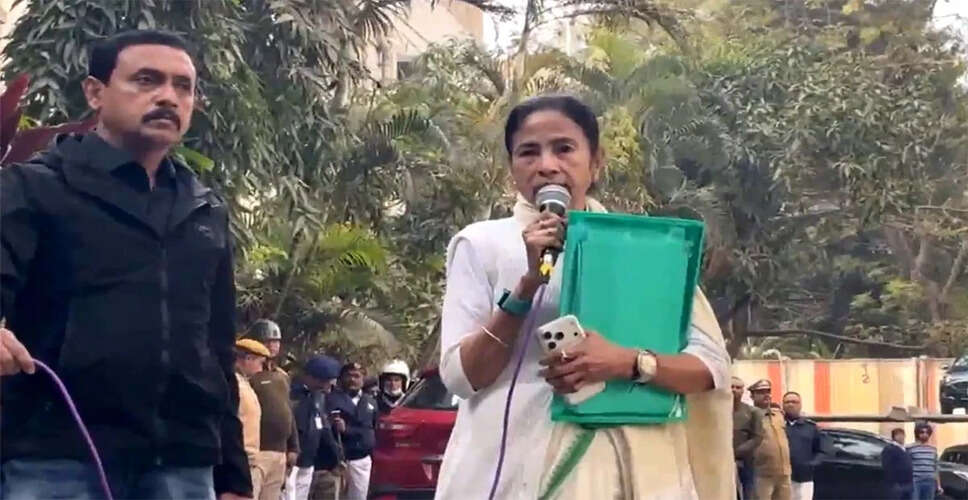
ED Raids Spark Political Controversy in West Bengal
The recent raids conducted by the Enforcement Directorate (ED) have once again shaken the political landscape of West Bengal. This time, the focus was on the I-PAC group, associated with the Trinamool Congress, and its leader, Pratik Jain, whose residence and office were targeted. As ED teams began their operations in Kolkata, Chief Minister Mamata Banerjee emerged with a confrontational stance, directly questioning Union Home Minister Amit Shah. She asked whether the Home Minister's role had devolved into intimidating opposition parties and forcibly extracting their internal information.
Mamata Banerjee's Response to ED Actions
Upon hearing about the ED's raid, Mamata Banerjee promptly visited Pratik Jain's location, where files and laptops were reportedly removed from the I-PAC office. This action drew criticism from the Leader of the Opposition in the West Bengal Assembly, Suvendu Adhikari, who labeled the Chief Minister's visit to Jain's residence as 'unconstitutional' and a 'direct interference' in the investigation by the central agency. Adhikari urged the ED to take action against the Chief Minister, recalling her previous visit to the residence of former Kolkata Police Commissioner Rajeev Kumar during a CBI raid.
Allegations of Political Conspiracy
Mamata Banerjee has accused the ED of conducting these raids not as part of a legal process but as a premeditated political conspiracy. She claimed that the central government is attempting to access the Trinamool Congress's electoral management, internal strategies, and documents through the misuse of agencies. Banerjee asserted that the central government has previously misused the CBI and ED, but insisted that Bengal would not yield.
ED's Focus on Financial Transactions
According to sources, the ED is particularly interested in I-PAC's financial transactions and certain questionable contracts. The agency claims to be searching for crucial documents and digital data. Meanwhile, the Trinamool Congress views this as a blatant interference, arguing that central agencies become active in Bengal whenever elections approach. In contrast, the Bharatiya Janata Party (BJP) has defended the ED's actions as lawful, questioning why there should be fear of investigation if no wrongdoing exists. The BJP asserts that the Trinamool Congress is mired in corruption, which is now being exposed, and accuses Banerjee of attacking the center to divert attention from the investigation.
BJP's Strategic Visit Amidst Political Unrest
Amidst this political upheaval, BJP National President J.P. Nadda has arrived in West Bengal for a two-day visit. He received a grand welcome at Kolkata Airport and has begun meetings with state unit president Samik Bhattacharya, Union Minister Sukanta Majumdar, and other leaders. According to the party, this visit is entirely focused on preparations for the upcoming assembly elections. Nadda will engage with district presidents, coordinators from various departments, and party workers, and will also participate in a doctors' meeting and visit health institutions. The BJP emphasizes that this visit is crucial for strengthening the organization at the booth level and enhancing electoral machinery.
The Intensifying Political Battle in West Bengal
It is evident that West Bengal's political arena has transformed into a battleground. The ED's raids and Mamata Banerjee's sharp reactions indicate that the forthcoming assembly elections will not merely be about votes but a struggle for power and existence. Banerjee describes this as an attack on Bengal's identity, while the BJP frames it as a decisive fight against corruption. The BJP is fully committed to its mission of conquering Bengal, with a clear strategy to target issues like corruption, misgovernance, and infiltration to corner the Mamata government. Amit Shah has already outlined this approach, and now Nadda is accelerating the organization in that direction, believing that disrupting the Trinamool's strategic and managerial framework could upset its electoral balance.
Potential Risks for BJP
However, the BJP also faces significant risks. If the public perceives the agency's actions as political vendetta, it could backfire. Emotions play a crucial role in Bengal's politics, and Mamata Banerjee is adept at turning every attack into a Bengal versus Delhi narrative.
Implications for Upcoming Elections
This entire sequence of events is pivotal in the context of the upcoming assembly elections. The ED's raids have heated the electoral atmosphere, shifting the focus from mere development or schemes to larger issues such as democracy, federal structure, and political freedom. While the BJP envisions a change in power, the Trinamool Congress is framing this as a battle for survival.
Conclusion: A Heated Political Climate Ahead
It is clear that politics in West Bengal is not going to remain subdued. The battle will be fierce, aggressive, and fought on all fronts. Agencies, organizations, streets, and social media will all play a role in this grand conflict. In the coming months, it will be determined who holds the key to power in Bengal, but it is certain that this election will profoundly influence the direction of national politics.