
Political Tensions Rise Over Women's Reservation Bill in India

Political Reactions to the Women's Reservation Bill
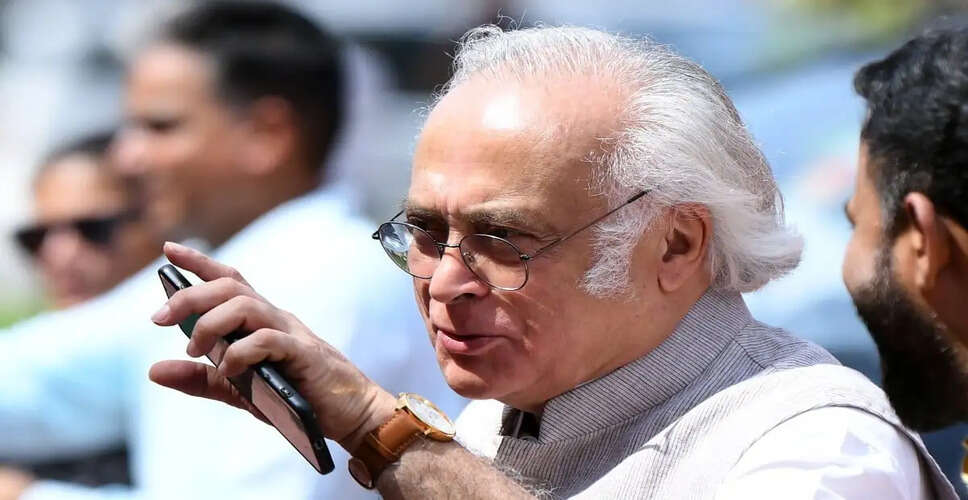
The political landscape in India is heating up once again due to the Women's Reservation Bill. The Congress party has sharply criticized Prime Minister Narendra Modi's recent article, labeling it as an electoral tactic. Congress General Secretary Jairam Ramesh accused the Prime Minister of taking a "U-turn" on this issue to gain support from women during the assembly elections in West Bengal and Tamil Nadu.
Ramesh stated on social media, "The Prime Minister has begun writing articles in the media to portray himself as the sole champion of women's reservation in the Lok Sabha and state assemblies. In reality, he should apologize to the women of India." He further mentioned that when the Nari Shakti Vandan Act, 2023 was unanimously passed by Parliament, Congress had called for its implementation starting in 2024, which the Prime Minister rejected.
He argued that the Prime Minister had made women's reservation contingent on the delimitation process and the census, which he failed to conduct and postponed for several years. Ramesh claimed, "Now, with the BJP's defeat in the assembly elections seemingly inevitable, the Prime Minister has changed his stance after 30 months. He wants us to forget about the census and the census-based delimitation, citing that it will take too long."
He added that this is despite the fact that the census registrar has clarified that the census results will be available by 2027. The Congress leader remarked, "This is a narrative built on lies and half-truths, all in the hope that women in Tamil Nadu and West Bengal will support the BJP. Ultimately, the BJP lacks any meaningful discourse on other issues in these states."
Ramesh asserted, "This is a U-turn by the Modi government, revealing its unwillingness to engage with the opposition and its complete lack of planning." He accused the Prime Minister of already claiming credit for this U-turn, stating, "There is no limit to his hypocrisy and deceit. This is all an attempt to cover up his significant failures in governance and serious setbacks in foreign policy."
Prime Minister Modi's Perspective on the Bill
On Thursday, Prime Minister Modi stated that the proposed amendments to the Women's Reservation Act are not merely a legislative process but a reflection of the aspirations of millions of women across India. He called on all MPs to unite in support of this initiative. In an article published on his website, Modi emphasized that this move reaffirms the principle that has long guided India's civilizational ideology: society progresses only when women progress.
Key Messages from Prime Minister Modi's Article
Earlier, Prime Minister Modi published an article on his website, describing women's reservation as a "reflection of millions of women's aspirations." The main points of his article included:
- Call for Unity: The Prime Minister urged all MPs to support this historic step.
- Civilizational Ideology: He stated that society progresses only when women progress, and this bill reaffirms that principle.
- Not Just a Legislative Process: According to the PM, this law is not merely on paper but is part of the civilizational thought of Indian society.