
Political Tensions Rise Over Kishau Multipurpose Project Agreement in Himachal Pradesh
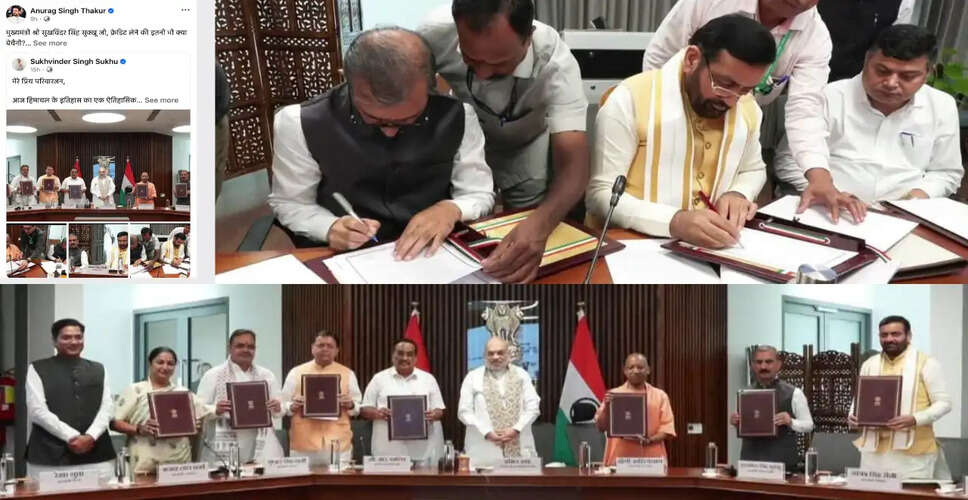

Political Dispute Erupts Over Kishau Project Agreement
The recent signing of the Kishau Multipurpose Project agreement has sparked a renewed political clash in Himachal Pradesh. Chief Minister Sukhvinder Singh Sukhu and Union Minister Anurag Thakur have presented contrasting views on who should be credited for advancing this long-stalled initiative.
Sukhu hailed the agreement as a monumental achievement for the state, asserting that his administration had secured a framework that safeguards Himachal Pradesh's financial interests.
In a message to the residents of Himachal Pradesh, Sukhu emphasized that his government had consistently opposed a previous arrangement that would have imposed a heavy financial burden on the state. He claimed that the new agreement would allow Himachal Pradesh to earn approximately ₹1,200–1,500 crore annually without needing to invest significantly.
The Chief Minister also highlighted the differences between the current agreement and the previous one, stating that his government rejected what it deemed an unfair financial structure.
However, Thakur quickly countered Sukhu's assertions, using social media to question the extent of the Himachal government's role in the project's progress.
Thakur remarked, "Credit-taking has its limits," arguing that the Kishau project is the result of a lengthy institutional and inter-state collaboration.
He noted that the project had been stagnant for decades until the Narendra Modi-led Central Government facilitated cooperation between Himachal Pradesh and Uttarakhand in 2014. Thakur also pointed to the establishment of the Kishau Corporation in 2017 as a pivotal step in moving the project forward.
According to Thakur, the current agreement is a product of cooperative federalism, involving the Centre and all six participating states rather than being solely attributed to one state government.
The Kishau agreement was finalized on Tuesday, with representatives from Himachal Pradesh, Uttarakhand, Uttar Pradesh, Haryana, Rajasthan, and Delhi present, alongside Union Home Minister Amit Shah and Union Jal Shakti Minister C.R. Patil. This agreement aims to address longstanding disputes regarding water sharing, project financing, and the distribution of benefits from the proposed initiative.
The Kishau project, which is set to be developed on the Tons river, is designed to create a significant multipurpose reservoir that will provide benefits such as water storage, drinking water supply, irrigation, and power generation. It is projected to produce around 1,379 million units of electricity each year.
A notable aspect of the new agreement is the financing arrangement for Himachal Pradesh. Under this agreement, Delhi and Rajasthan will cover Himachal's project costs in a 75:25 ratio, reflecting the water benefits each state will receive. In return, Himachal will receive financial compensation for the electricity generated from its share of the project.
The Centre is also set to provide considerable financial backing for the water component of the initiative.
Adding another layer to the political discourse, former Chief Minister and Leader of Opposition Jai Ram Thakur welcomed the agreement while underscoring the Central Government's role and the collaboration of the participating states in resolving this long-standing issue.
Thakur's comments have introduced a new dimension to the political debate, especially since the Kishau project has undergone numerous negotiations under various administrations.
The BJP contends that the project should not be viewed solely through the lens of the current Himachal government, given the Centre's involvement in uniting the states and facilitating the final agreement.
Conversely, the Congress government asserts that the significant achievement for Himachal lies in the modification of the financial arrangement and the protection of the state's interests.
The political contention surrounding Kishau is evolving into a struggle over narrative as much as it is about the project itself.
For the Sukhu administration, the agreement signifies the result of its insistence that Himachal should not bear an inequitable financial burden for a project that benefits multiple states.
For the BJP, the agreement illustrates the Centre's role in resolving a protracted inter-state issue through negotiation and consensus among six governments.
Beyond the political claims, the broader significance of the agreement is clear: after years of delays and disputes, the six participating governments have now formally committed to a unified framework for advancing the Kishau project.
The next phase will involve translating the agreement into actionable steps, including financial arrangements, statutory approvals, and construction processes.
However, for Himachal Pradesh, the immediate political question remains — will Kishau be remembered as a triumph of the state government's negotiations or as the result of a broader Centre-led, multi-state initiative?
With both sides asserting their claims, the Kishau project has gained new political momentum even before construction has commenced.