
Political Tensions Rise in Maharashtra Over Language and Identity Issues
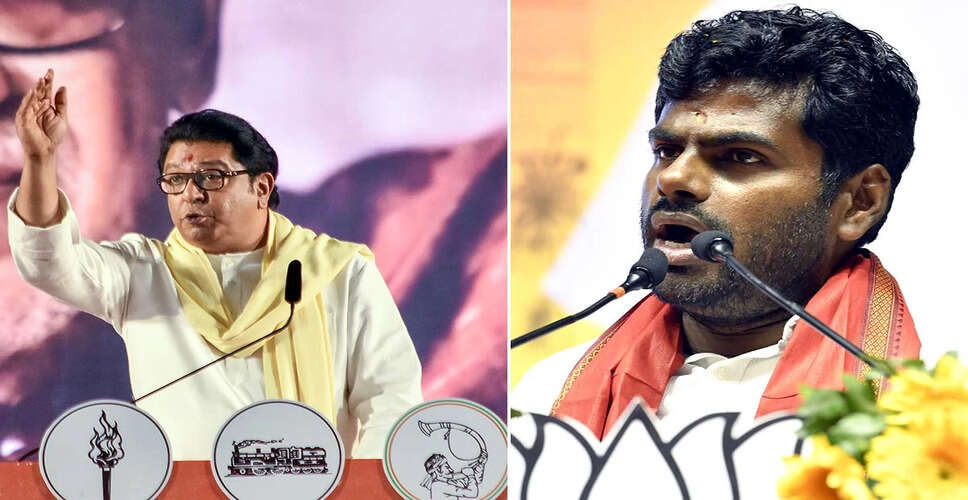
Political Disputes Emerge in Maharashtra
The political landscape in Maharashtra is once again embroiled in controversy surrounding language and identity. Tensions escalated following sharp exchanges between K. Annamalai, the former president of the Tamil Nadu BJP, and Raj Thackeray, the leader of the Maharashtra Navnirman Sena. The situation intensified when Thackeray made a sarcastic remark about Annamalai during a public rally, questioning the relevance of a person from Tamil Nadu in Maharashtra's politics by referring to him as 'Ras Malai'.
Thackeray's Concerns Over Outsiders
During his speech, Thackeray referenced historical regional slogans, suggesting that the influence of outsiders in Maharashtra is growing. He emphasized that Mumbai and Maharashtra have been built through the hard work of Marathi people and that any attempt to impose a foreign language would not be tolerated. He framed this as a matter of Marathi identity, declaring the upcoming Mumbai Municipal Corporation elections as crucial for the Marathi community. Thackeray also rallied support with the slogan 'Utha Lungi Baja Pungi', further heating the atmosphere.
Annamalai's Defiant Response
In response, K. Annamalai delivered a bold and confident statement, asserting that he would not be intimidated by threats or violence upon arriving in Mumbai. He questioned why any leader has the right to divide people into North Indian or South Indian categories if India is indeed one nation. Annamalai highlighted that individuals from all corners of the country contribute to Mumbai's growth, intensifying the political climate and indicating that language and identity will be significant issues in the upcoming elections.
Historical Context of Thackeray's Statements
Thackeray's past remarks against North and South Indians are not new, but the changing political dynamics could lead to more serious repercussions than before. Politics in a metropolis like Mumbai has transcended the Marathi versus non-Marathi narrative. The city now symbolizes economic opportunities and cultural diversity, and targeting any single community could provoke widespread discontent.
Shifting Political Alliances
Thackeray's political stance has long revolved around Marathi identity. Initially, this approach benefited him, but the social fabric of Mumbai and Maharashtra has evolved. Today, a significant portion of the North Indian, Gujarati, and Marwari communities stands firmly with the BJP, and a notable segment of the Marathi community has also aligned with the party. Thus, aggressive rhetoric against any community could inadvertently benefit the BJP.
Implications for Shiv Sena UBT
The Shiv Sena UBT is already grappling with division and organizational weaknesses. In such a climate, if its leaders make sharp statements against a particular community, it could further erode the party's political base. In elections like the Mumbai Municipal Corporation, where every vote counts, such rhetoric could alienate non-Marathi voters and even discomfort some Marathi voters.
Annamalai's Image as a Fearless Leader
K. Annamalai is perceived as a fearless and straightforward leader. His political journey conveys that politics can be conducted not just through caste, language, or region, but also through courage, ideas, and integrity. He resonates with the youth, as he does not shy away from confrontation while linking his discourse to national unity. Today's young voters prefer leaders who are confident and transcend narrow-minded thinking. Annamalai's rhetoric reflects a sense of self-defense and dignity rather than hatred towards any community, contributing to his rising popularity among the youth.
Long-term Consequences of Divisive Politics
While Thackeray's divisive rhetoric may capture headlines in the short term, the long-term political ramifications could be detrimental. Leaders like Annamalai suggest that future politics will advance by breaking down identity barriers rather than erecting them. The political landscape in Mumbai and Maharashtra is at a juncture where voters are increasingly prioritizing practicality and inclusive thinking over emotional appeals.