
Political Tensions Rise in Assam Ahead of 2026 Assembly Elections
Political Climate Heating Up
Guwahati, Jan 11: As the 2026 Assam Assembly elections approach, the political atmosphere in the state is becoming increasingly charged, with the Congress party and the ruling Bharatiya Janata Party (BJP) intensifying their verbal exchanges.
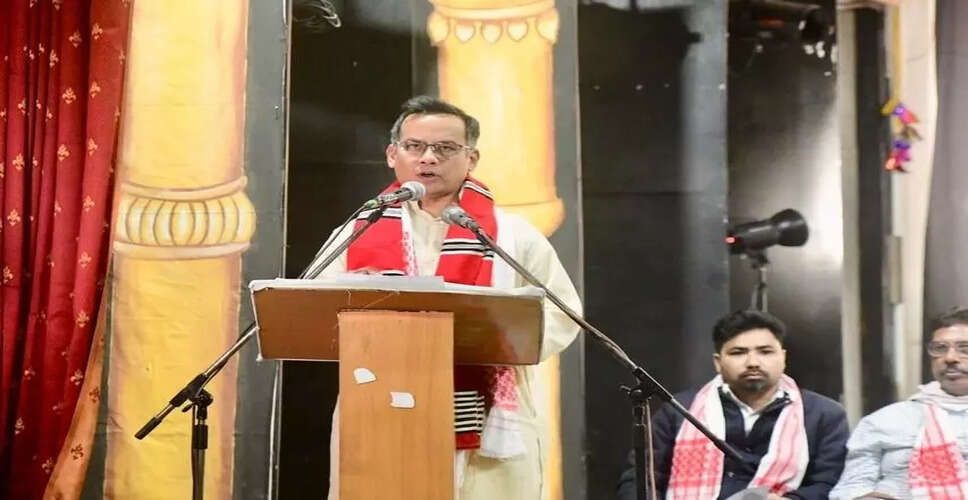
In a bid to set a more aggressive campaign tone, Gaurav Gogoi, president of the Assam Pradesh Congress Committee (APCC), took a pointed jab at Chief Minister Himanta Biswa Sarma during a recent event in Guwahati, echoing a famous phrase from his father, former chief minister Tarun Gogoi.
While speaking at a joining ceremony at the Manabendra Sarma Complex, Gogoi posed a provocative question to the audience, asking, “Who is Himanta Biswa Sarma?”
He reminisced about his father's impactful political statements, noting that a similar question directed at an AIUDF leader had resonated with the public in the past.
“When the people of Assam unite against fear and syndicate politics, they too will inquire, ‘who is Himanta Biswa Sarma?’” he asserted, emphasizing that the party's mission is to empower the populace, stating that real authority belongs to the citizens rather than to individuals.
The BJP quickly countered these remarks, with party leader Alokmoni Bhattacharya defending Sarma vigorously, labeling him as “the best chief minister Assam has ever had.”
“Is Badaruddin Ajmal comparable to Himanta Biswa Sarma? Absolutely not,” Bhattacharya remarked, highlighting Sarma’s achievements in development and cultural preservation that are well recognized by the Assamese people.
He further questioned the Congress leadership's connection to Assamese identity, suggesting that voters are aware of the accomplishments of the BJP government. “How can someone who struggles with the Assamese language effectively serve Assam?” he challenged.
Amidst the escalating verbal conflict, the Congress party is also emphasizing its policy priorities, particularly regarding tribal matters, by officially receiving a detailed report from a Core Scheduled Tribe (ST) Study Group.
This report is anticipated to significantly influence the party's manifesto for the upcoming elections.
The Congress claims that the group conducted thorough field research across various constituencies, engaging with tribal organizations, NGOs, and community members from groups such as Rabha, Garo, Bodo, Hajong, Amri Karbi, Tiwa, and Mising.
The report highlights serious concerns regarding the infringement of tribal land and forest rights, citing examples of land being transferred to non-ST and non-local entities, which has resulted in economic marginalization and livelihood insecurity.
Key recommendations for the Congress manifesto include stringent enforcement of laws safeguarding tribal land, the issuance of bhumi patta to legitimate tribal forest dwellers, the establishment of a Tribal University in Assam, granting ST status to the Amri Karbi community, incorporating the remaining 312 Bodo revenue villages into the Bodo Kachari Welfare Autonomous Council, and forming Development Councils for plains tribal groups currently lacking such representation.
The APCC has confirmed that the report has been submitted to the party president and will serve as a vital basis for developing an inclusive and tribal-centric manifesto in preparation for the 2026 Assembly elections.