
Political Tensions Erupt in Himachal Pradesh Over Social Media Post
Political Fallout from a Social Media Incident
S Gopal Puri
Dharamshala: – A seemingly innocuous social media post has sparked significant political tension in Himachal Pradesh. What was intended as a standard display of protocol during Vice President C.P. Radhakrishnan's visit has reignited a longstanding rivalry between two prominent BJP MLAs: Pawan Kajal from Kangra and Sudhir Sharma from Dharamshala.
The controversy began on Saturday when Vice President Radhakrishnan arrived in the hill town to attend the 9th Convocation of the Central University of Himachal Pradesh and to honor the War Memorial. Both Kajal and Sharma, key figures in the BJP within the district, were present at the airport to greet the Vice President.
The ‘Invisible’ Colleague
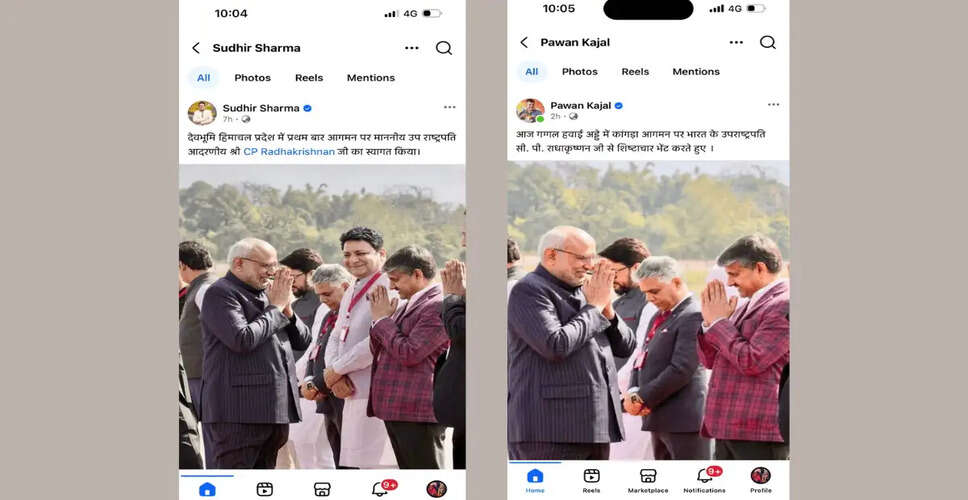
The incident that has captured public attention originated from the social media posts of the two leaders. While both shared images from the welcoming event, observant netizens quickly noted a significant omission. In the photos posted by Pawan Kajal, Sudhir Sharma was conspicuously absent, or rather, appeared to have been intentionally cropped out.
Conversely, Sharma's posts included the entire scene of the reception, showcasing Kajal as well.
This ‘cropping incident’ has rapidly gained traction across local WhatsApp groups and social media, with supporters and detractors debating whether it was an unintentional mistake or a deliberate political slight.
Historical Context: A Rift from 2019
For experienced political analysts in Kangra, this is not merely a social media mishap. The incident has resurfaced a grievance that dates back seven years.
In 2019, when both leaders were part of the Indian National Congress, a significant divide emerged during the Lok Sabha elections. Sudhir Sharma, a powerful former minister at the time, reportedly chose not to contest the Kangra parliamentary seat, leading the party to nominate Pawan Kajal against the BJP's Kishan Kapoor.
Kajal faced a devastating defeat, losing by an unprecedented margin of over 4.77 lakh votes. The prevailing narrative suggested that Kajal felt he had been unfairly made a ‘scapegoat,’ with rumors indicating that Sharma's refusal to run and his perceived lack of support during the campaign contributed to Kajal's substantial loss.
Same Party, Old Grudges?
Today, the political dynamics have changed significantly. Both leaders have since joined the BJP—Kajal in 2022 and Sharma more recently in 2024 after a dramatic Rajya Sabha cross-voting incident.
However, the ‘photo-cropping’ controversy indicates that despite their shared party affiliation, the shadows of their Congress past continue to affect their relationship.
A local political analyst remarked, “In politics, what is omitted from the frame often holds more significance than what is included. By cropping Sudhir out of the photo, Kajal has indicated that the wounds from 2019 remain unhealed.”
Neither leader has publicly addressed the social media post, and their silence has only intensified speculation. Within the BJP, this public display of discord raises concerns, particularly as the party aims to present a united front in the politically vital Kangra region. As the Vice President wraps up his visit, the residents of Dharamshala find themselves discussing not the convocation speeches, but the intriguing case of the missing MLA.