
Political Dynamics Heat Up in Central Guwahati Ahead of Assembly Elections
Political Climate Intensifies in Central Guwahati
Guwahati, March 9: As Assam approaches the Assembly elections, the political atmosphere in Kamrup (Metropolitan) district is increasingly vibrant.
This article is the third installment in a series examining the district's five Assembly seats, with a spotlight on Central Guwahati, which has become a focal point in the political arena following the recent delimitation process.
The forthcoming elections will mark the first Assembly poll after the redrawing of constituency lines, significantly altering the political landscape in various regions of the state.
Residents from areas such as Kalapahar, Bharalumukh, and Bishnu Nagar express a common set of concerns as they engage in discussions about the upcoming elections.
As political parties evaluate their chances and numerous candidates seek party nominations, a key question arises: what do the voters of Central Guwahati desire from their future representative?
Challenges in Kalapahar: Dust, Delays, and Water Shortages
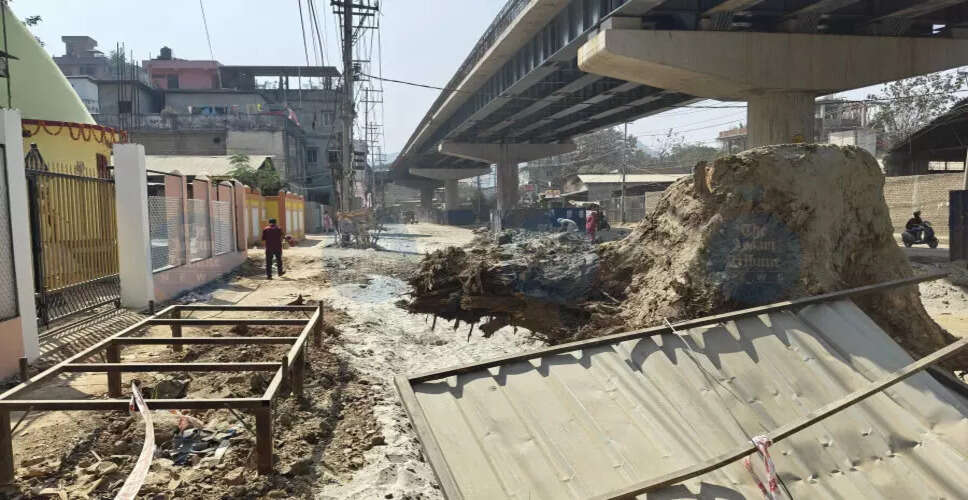
In Kalapahar, where a flyover is under construction, locals acknowledge the long-term benefits of the project but are currently facing significant short-term challenges.
Babulal Adhikari, a local resident, shared the ongoing difficulties faced by the community. “For the past two years, we have endured constant hardships. The roads are in terrible condition, making daily commutes extremely challenging. The dust from the construction is unbearable, and there seems to be little effort to mitigate it. It feels as though the administration is oblivious to our struggles,” he stated.
Adhikari emphasized that the drinking water crisis is the most urgent issue for residents. “The pipelines are malfunctioning, leading to irregular supply. At times, we go days without water. With elections approaching, leaders will come seeking votes, but few understand our daily challenges,” he added.
Another resident, Ratan Putdar, echoed these sentiments, describing the water shortage as a long-standing problem. “The water situation is dire. There is hardly any drinking water available, and the damaged roads complicate mobility,” he remarked.
Bharalumukh: Development vs. Traffic Concerns
In Bharalumukh, while residents recognize that new infrastructure like the flyover signifies development, they question its effectiveness in addressing local issues.
Dhananjay Sarma, a local, expressed concerns that the infrastructure project might exacerbate traffic congestion. “The flyover could provide some advantages, but increased traffic from the Brahmaputra bridge will likely worsen congestion near gates 7, 8, and 9. The intersection by the fish market is already hazardous due to heavy traffic,” he noted.
Sarma also pointed out that while infrastructure projects are often seen as progress, they can disrupt local livelihoods. “The flyover may enhance connectivity on paper, but it has also eliminated parking spaces in areas like Santipur and Bharalumukh,” he stated.
Senior citizen Basanta Sen Deka offered a more nuanced view, acknowledging some development while stressing the need for improved essential services. “While the government has undertaken development projects, drinking water remains a significant issue. We do receive some supply now, but it is still inadequate,” he said.
Bishnu Nagar: Ongoing Civic Issues
In Bishnu Nagar, residents continue to voice concerns over the drinking water crisis. Local resident Gautam Bora highlighted that drainage and canal infrastructure also require urgent attention.
“The canals lack proper embankments, and construction work remains incomplete in several areas. Years ago, the MLA promised to resolve the drinking water issue, but it persists,” he remarked.
Bora added that while discussions and promises have been frequent, tangible solutions have been scarce. “Some work has started, but it has not progressed as expected,” he noted.
Hill Residents Demand Basic Amenities and Land Rights
In the hill areas of Central Guwahati, including Adingiri Hill, residents face multiple challenges. Elderly resident Nilkantha Das identified three primary issues: inadequate water supply, poor sanitation facilities, and the lack of land ownership documents. “Without land rights, families live with constant uncertainty about their future,” he explained.
Women in the community also highlighted the daily struggles caused by poor infrastructure. Moromee Biswas stated, “The roads are in terrible condition. During elections, leaders make numerous promises, but few are fulfilled. The lack of water and proper roads complicates daily life.”
Another resident, Dipika Phukan, shared similar frustrations. “The roads are in awful shape, and there is almost no reliable water supply. Poor road conditions make even basic commuting very difficult,” she said.
Local resident Gokul Roy emphasized that these issues have persisted for a long time. “Drinking water is a major challenge here, and we also face land ownership issues. Many have lived in these areas for years without proper land rights. Leaders talk about resolving these issues, but concrete actions are yet to be seen,” he concluded.
Political Aspirants Share Their Perspectives
With numerous candidates vying for party nominations in the constituency, political leaders are presenting varied narratives regarding the development trajectory of Central Guwahati.
Congress candidate Bandip Dutta framed the election as a contest between the ruling party and the public's grievances. “This election is fundamentally about the BJP government versus the common people. Issues like drinking water shortages, artificial flooding, poor drainage, and damaged pipelines remain unresolved even after years of governance,” she stated.
Dutta also highlighted the concerns of residents in Guwahati's hill areas. “Nearly four lakh people live in the hills of Guwahati, and a significant number still lack land ownership. If Congress forms the government, we will ensure that hill residents receive land rights,” she promised.
Conversely, BJP candidate Devan Dhrubajyoti Morle expressed confidence in the party's prospects in the newly delineated constituency. “Central Guwahati has historically shown strong support for the BJP. In the last election, the seat went to our alliance partner AGP, but the BJP's organizational strength remains robust here. People have benefited from government schemes, and their trust in the government has grown,” he asserted.
Sitting MLA's Optimism
Sitting BJP MLA Ramendra Narayan Kalita also expressed optimism about retaining the seat in the upcoming election. “This will be the first election in the newly structured constituency after delimitation, and we are confident about our prospects. Development work has been carried out throughout the constituency, including improvements in national highways and local infrastructure,” Kalita stated.
He acknowledged that some issues remain unresolved but assured that efforts are being made to address them. “In certain areas, sub-roads still require improvement, and work on drinking water projects is ongoing. By July or August, the water supply schemes will be operational. Additionally, under Basundhara 5.0, land rights will be granted to eligible residents,” he added.
As election campaigns gain momentum, the voices emerging from Central Guwahati reflect a familiar electoral narrative seen across many urban constituencies in Assam, showcasing visible development projects alongside unresolved civic issues.
As Central Guwahati gears up for its first Assembly election following the restructuring, the constituency finds itself at a pivotal moment. The election outcome may hinge less on campaign rhetoric and more on whether voters believe their next legislator will finally address these long-standing civic challenges.