
Political Controversy Arises from Prithviraj Chavan's Remarks on Venezuela
Prithviraj Chavan, a senior Congress leader, has sparked a political uproar with his controversial comments regarding Venezuela, accusing the Indian government of avoiding a clear stance due to U.S. pressure. His remarks have led to a heated debate about India's foreign policy and the implications of fear-based politics. Critics argue that such comparisons undermine India's democratic strength and stability. Chavan's history of provocative statements raises questions about the maturity of political discourse in India. This article delves into the implications of his comments and the broader context of India's international relations.
| Jan 6, 2026, 11:58 IST
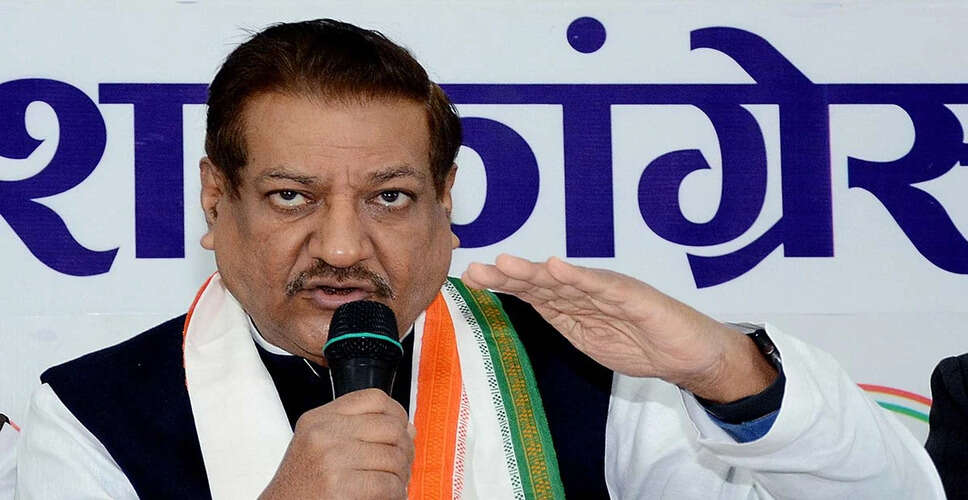
Controversial Statements Ignite Political Debate
Senior Congress leader and former Chief Minister of Maharashtra, Prithviraj Chavan, has stirred political controversy once again with his provocative remarks. He criticized the central government regarding the situation in Venezuela, alleging that the Indian government is avoiding a clear stance due to pressure and fear from the United States. Chavan stated that the actions taken by the U.S. against Venezuela's president and its political system violate international norms and sovereignty.
Concerns Over India's Foreign Policy
He further claimed that if the Indian government continues to exhibit such a weak and fearful attitude, a similar situation could arise in India in the future. According to Chavan, India should have taken a definitive stand on this issue, but the government remains silent to avoid confrontation with the U.S. His comments have intensified political disputes, with the ruling party labeling them as irresponsible and detrimental to the country's foreign policy, while Congress supporters hailed them as courageous.
Chavan's History of Controversial Remarks
This is not the first instance where Prithviraj Chavan has made sharp and controversial comments on sensitive issues related to national or international security. His latest statement is seen as part of a pattern where he often presents conclusions based more on fears and exaggerations than on facts.
Misleading Comparisons
Chavan's assertion that India could face a situation akin to Venezuela's is not only exaggerated but also a blatant insult to India's political, economic, and institutional strength. This statement reflects more political desperation than the maturity expected from an experienced leader. It is unreasonable for any responsible politician to instill fear regarding the country's sovereignty and stability.
India vs. Venezuela: A False Equivalence
Comparing India with Venezuela is inherently misleading. Venezuela has struggled with economic mismanagement, political instability, institutional decay, and international isolation for years. Its economy has collapsed, democratic institutions have weakened, and power struggles have hollowed out the nation. In contrast, India is a robust democracy where power transitions occur within constitutional bounds, the judiciary is independent, the media is active, and the military operates under professional and constitutional oversight.
Fear Politics vs. Rational Discourse
Chavan's primary issue lies in his framework of presenting every international crisis as a potential threat to India. This is fear-based politics, not rational discourse. Such statements create confusion and insecurity among the public, while the reality is far from it. India is neither diplomatically isolated nor does its foreign policy operate at the behest of a single nation.
India's Multifaceted Foreign Policy
Chavan seems to overlook that India's foreign policy is multidimensional. India maintains relationships with the U.S., Russia, Europe, as well as Asia and Africa. Responding thoughtfully and balanced to a single issue is not a sign of weakness but rather an indication of diplomatic maturity. Immediate statements in every international dispute are not always necessary; sometimes silence is a strategy, not fear.
Chavan's Pattern of Controversy
Prithviraj Chavan's record shows that he often prefers to remain in the headlines through controversial statements. Whether related to military issues or foreign policy, he has made claims that often do not align with ground realities. Such remarks neither strengthen national security nor contribute meaningfully to democratic discourse; instead, they raise questions about the opposition's responsibility.
The Impact of Misleading Comparisons
It is crucial to understand that comparing India to any unstable or failed nation damages the country's image. India's economic potential, democratic framework, technological advancement, and global role place it on a distinctly different level than countries like Venezuela. Here, power cannot be toppled at the behest of foreign forces, nor are India's institutions so weak that they would collapse under external pressure.
The Need for Responsible Critique
Ultimately, leaders like Prithviraj Chavan must recognize the difference between criticism and irresponsible statements. Questioning government policies is part of democracy, but instilling fear with baseless comparisons is a sign of political immaturity. A situation like Venezuela cannot occur in India, as the country's roots are strong, its institutions are alive, and its democracy does not depend on a single individual or foreign power.