
PM Modi Celebrates the Resilience of Somnath Temple in Gujarat
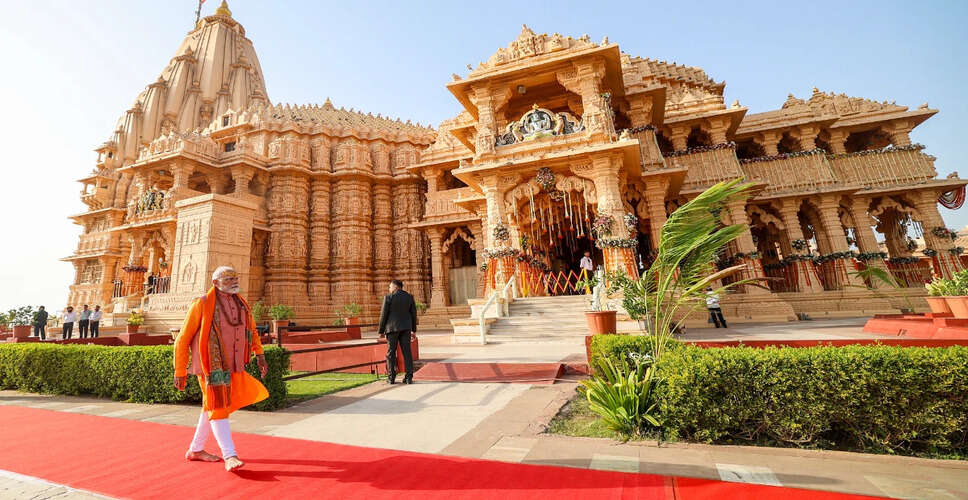
The Significance of Somnath
The name Somnath evokes a sense of pride and reverence, symbolizing the eternal spirit of India. Located in Prabhas Patan, Gujarat, this magnificent temple stands as a testament to India's cultural heritage. The Dwadasa Jyotirlinga Stotra mentions twelve Jyotirlingas across the country, starting with "Saurashtrē Somnathṃ cha," highlighting Somnath's historical and spiritual importance.
PM Modi Praises Somnath Temple
On Monday, Prime Minister Narendra Modi lauded the Somnath Temple in Gujarat, which has been rebuilt after enduring numerous invasions by foreign attackers. In a blog post commemorating the 1,000th anniversary of the temple's first attack, he remarked, "There is no better example of the indomitable spirit of our civilization than Somnath, which stands tall despite challenges and struggles." He noted that the temple, which faced its first assault in 1026, continues to stand proudly today.
A Symbol of Courage and Resilience
The Prime Minister emphasized that the story of Somnath reflects the unwavering courage of countless children of Mother India who have defended our culture and civilization. He pointed out that this spirit is evident throughout the nation, which has emerged as one of the brightest spots for global development after centuries of invasions and colonial plunder.
Modi stated, "It is our value systems and the determination of our people that have made India the center of global attention today. The world looks at India with hope and optimism, eager to invest in our innovative youth."
Cultural Heritage and Global Impact
He further remarked, "Our art, culture, music, and festivals are gaining international recognition. Yoga and Ayurveda are making a global impact, promoting healthy living. Solutions to some of the most pressing global challenges are emerging from India."
The Prime Minister noted that past invaders have become mere "dust in the air," their names synonymous with destruction. He stated, "They are footnotes in the pages of history, while Somnath shines brightly, spreading light far beyond the horizon, reminding us of the eternal spirit that remains unbroken since the attack of 1026."
A Vision for a Developed India
With the blessings of Shri Somnath Mahadev, Modi expressed a commitment to building a developed India, where the understanding of our civilization guides efforts for the welfare of the entire world.
The temple has faced multiple attacks and looting, including the invasion by Turkish ruler Mahmud of Ghazni in 1024. Modi recalled the significant role played by Sardar Vallabhbhai Patel in the temple's reconstruction post-independence.
Historical Context of Somnath Temple
In 1299, Alauddin Khilji's general Alaf Khan destroyed the temple again, taking its remnants to Delhi. Hindu rulers later rebuilt it. In 1394, the governor of Gujarat, Muzaffar Khan, once more demolished the temple. It was reconstructed again, but in 1459, Mahmud Begada or Muzaffar II desecrated it.
The temple continued to serve as a sacred pilgrimage site for Hindus until 1669 when Aurangzeb ordered its demolition along with other Hindu temples. In 1702, he commanded the complete destruction of Somnath, and by 1706, it was converted into a mosque.
Recognizing the need for continuity, Rani Ahilyabai Holkar built a new temple nearby in 1783, placing the sacred lingam in a secret underground temple beneath the main structure to protect it from destruction.