
Parliament's Budget Session Set for Turbulent Start: Opposition Targets Speaker Om Birla
Parliament's Budget Session Begins Amidst Tensions
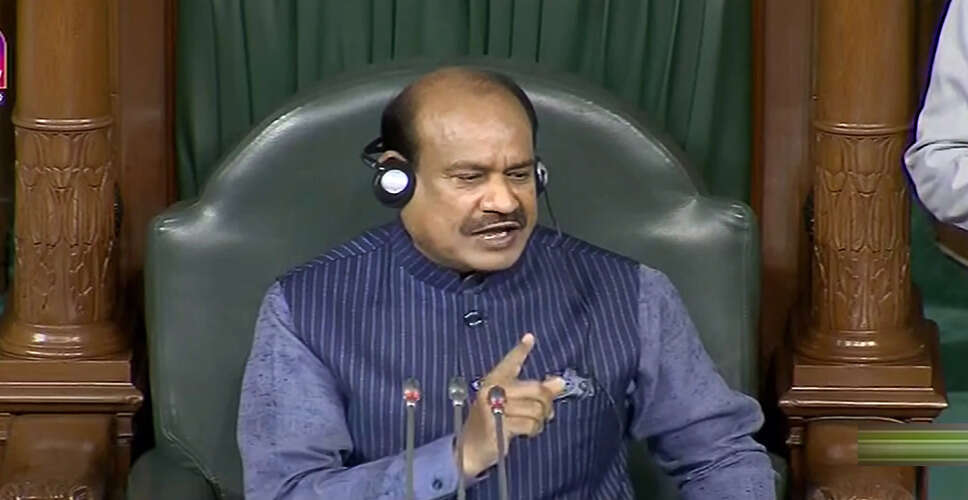
The second half of the Budget session in Parliament is poised to commence with significant tension on Monday, as the Lok Sabha prepares to address a resolution proposed by the opposition aimed at the removal of Speaker Om Birla.
The ongoing crisis in West Asia is anticipated to be a major topic of discussion, with opposition parties criticizing the government's approach towards Iran and the US's waiver concerning India's oil purchases from Russia, among other pressing issues.
Additionally, the implications of the Special Intensive Revision (SIR) of electoral rolls in West Bengal, which resulted in the removal of approximately 6 million votes, are expected to influence the parliamentary discussions.
The no-confidence motion against Birla has been initiated by various opposition leaders who claim he has displayed a 'blatantly partisan' attitude within the House.
They have also accused him of making misleading statements regarding Congress members, particularly when he referred to some 'unexpected actions' in the Lok Sabha and advised Prime Minister Narendra Modi against attending the debate on the Motion of Thanks for the President's Address.
Birla has stepped back from the House proceedings since the notice was submitted, with the Lok Sabha secretariat indicating he will return only after the agenda is addressed.
Prime Minister Modi expressed his support for Birla on Saturday, asserting that he has worked collaboratively with all Parliamentarians and is dedicated to upholding the Constitution and the principles of parliamentary democracy.
In addition to the no-confidence motion, the session is likely to address the recent US-Israel strikes on Iran and the escalating tensions in West Asia, which have disrupted crude oil supplies and driven up prices, prompting the opposition to challenge the government's policies.
Members of the Trinamool Congress (TMC) are expected to raise concerns regarding the SIR issue, while the BJP may highlight a 'protocol breach' involving President Droupadi Murmu during her recent visit to West Bengal.
The government is also anticipated to introduce the Electricity Amendment Bill during this session, alongside other legislative matters that were pending from the first half.
According to the agenda for Monday, the resolution concerning the Speaker is the sole item scheduled for discussion in the Lok Sabha.
Both the ruling BJP and the main opposition party, Congress, have instructed their Lok Sabha MPs to be present when this issue is deliberated.
The government holds a significant majority, which is likely to ensure the resolution's defeat.
The Congress has called for a debate on the notice submitted by 118 MPs, while the TMC has expressed its intention to support the motion against Birla.
It is possible that the Lok Sabha will not conduct the Question Hour between 11 am and 12 noon on Monday, as it may be adjourned to honor the memory of sitting member Ricky Syngkon from Shillong, who passed away on February 19.
Historically, three Lok Sabha speakers—G V Mavlankar (1954), Hukam Singh (1966), and Balram Jakhar (1987)—have faced no-confidence motions, all of which were ultimately rejected.