
Pakistan Introduces FATAH-3 Missile Amidst Rising Military Tensions
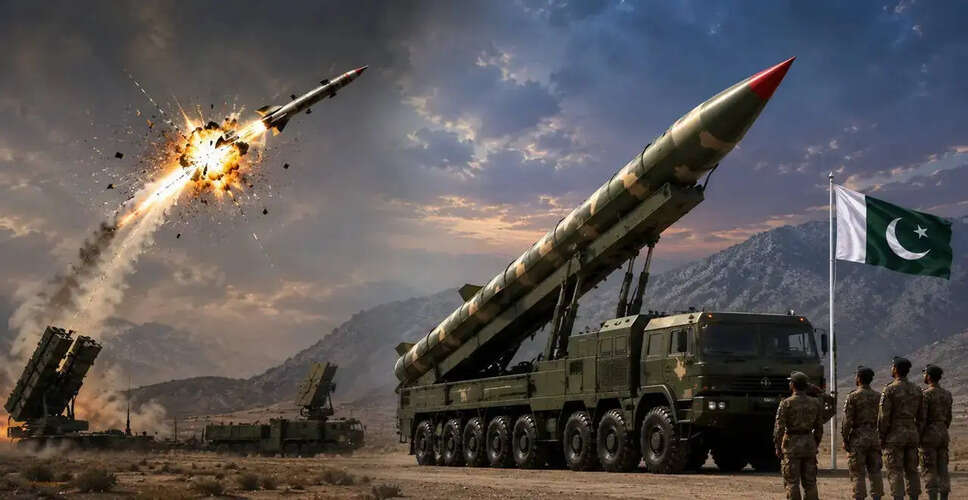

Introduction of FATAH-3 Missile
Nearly a year after concerns were raised regarding the effectiveness of Pakistan's Fatah-2 missile during Operation Sindoor, the country has unveiled its latest FATAH-3 supersonic cruise missile. This development is perceived as a strategic move to enhance its military capabilities. The new missile system is believed to be based on China's HD-1 technology, highlighting the close military collaboration between Islamabad and Beijing. This advancement is also seen as a response to India's BrahMos missile, especially after India successfully executed precision strikes against terror camps in Pakistan and Pakistan-occupied Kashmir (PoK), targeting even Pakistan's airbases.
During Operation Sindoor in May of the previous year, Pakistan faced embarrassment when its Fatah-II guided missile, aimed at Delhi, was intercepted by India's air defense system over Haryana before it could reach its destination.
Key Features of FATAH-3 Missile
The FATAH-3 missile boasts a terminal velocity ranging from Mach 2.5 to Mach 4, along with terrain-hugging and sea-skimming capabilities. Reports suggest that it can complicate radar tracking and features a layered interception system, which could shorten interception timelines for conventional air defense networks.
Additionally, Pakistan recently tested an upgraded version of the Fatah-II missile, which is said to include advanced avionics and state-of-the-art navigation systems, features that were lacking in its predecessor.
Shortcomings of Fatah-II
The Fatah-II, an enhanced version of the original Fatah-1 missile system, is designed as a guided multiple-launch rocket system (MLRS) capable of launching precision-guided rockets with a strike range of up to 400 kilometers. However, its vulnerabilities were exposed during Operation Sindoor when India's air defense systems successfully intercepted it before it could hit its target.
Pakistan's Dependence on China for Military Equipment
Pakistan relies heavily on China for approximately 80% of its military hardware. On the first anniversary of Operation Sindoor, Lt General Rajiv Ghai emphasized the depth of the partnership between Pakistan and China, describing it as one 'deeper than the seas, higher than the mountains,' which underscores the strategic challenges faced by India.
He acknowledged that the majority of Pakistan's military equipment originates from China, and highlighted the complexities of potentially facing multiple adversaries, including Turkey, China, and Pakistan, simultaneously.
Overview of Operation Sindoor
Operation Sindoor by India resulted in significant damage to terror infrastructure and military assets across the border, with officials reporting the neutralization of multiple high-value targets in a precise response to the April 22 Pahalgam terror attack. The operation included airstrikes on nine terror infrastructures in Pakistan and PoK, reportedly eliminating around 100 terrorists.
Targets included the Jaish-e-Mohammed (JeM) headquarters in Bahawalpur, the Lashkar-e-Taiba base in Muridke, and various terrorist infrastructures in Sialkot, Muzaffarabad, and other locations. This action led to heightened tensions, with Pakistan launching retaliatory strikes on military and civilian sites, which were successfully countered by the Indian military. The hostilities concluded with an agreement to cease military actions on May 10 after discussions between army officials from both sides.