
Pakistan Declares Open Conflict with Afghanistan Amid Rising Tensions
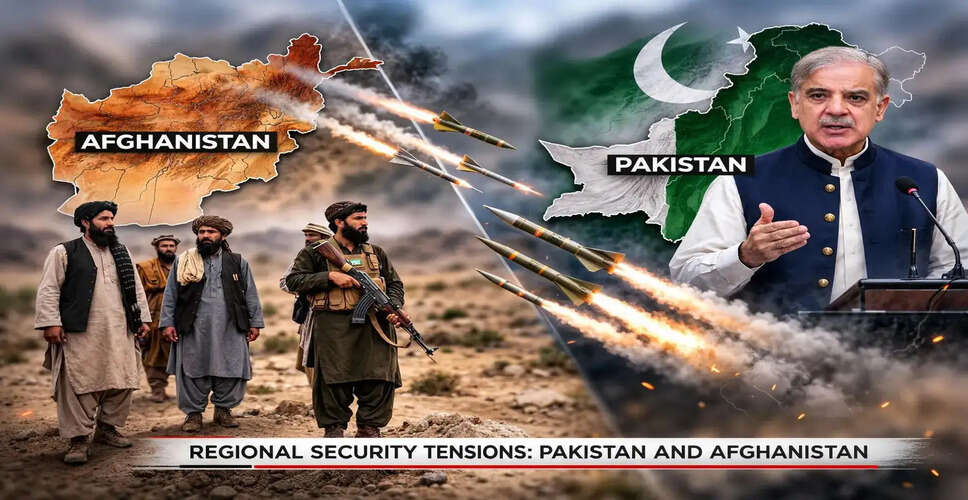
Escalation of Hostilities
On Thursday, Khawaja Mohammad Asif, the Defence Minister of Pakistan, announced an "open war" against Afghanistan following a new wave of violence and airstrikes along their shared border. He expressed on X that, "Our patience has reached its limit. Now it is open war between us and you," highlighting the escalating tensions between Islamabad and Kabul. Just hours prior to this declaration, Afghanistan had launched retaliatory strikes against Pakistan near the border. The Ministry of Information and Broadcasting in Pakistan reported that the Afghan Taliban initiated "unprovoked firing on multiple locations across the Pakistan-Afghanistan border." Islamabad is asserting its need to protect its territorial integrity amid ongoing security incidents. The situation has been further complicated by a series of violent exchanges along the 2611 km Durand Line, a disputed border that Kabul does not recognize, along with other cross-border attacks.
In response, Pakistan's air force conducted several raids targeting what it claims are hideouts of Tehrik-i-Taliban Pakistan (TTP) and other militant groups in Afghanistan's eastern provinces. Kabul has condemned these airstrikes as violations of its sovereignty. However, analysts suggest that Pakistan's aggressive rhetoric may not align with its actual military capabilities, raising doubts about whether the threats are politically motivated or genuinely substantive.
Military and Geopolitical Constraints
Pakistan's Military And Geopolitical Limitations
Despite the intense rhetoric, Pakistan must acknowledge its military and geopolitical constraints. The armed forces are already engaged in internal security operations against the TTP and Baloch insurgents. Additionally, the country is grappling with an economic crisis that limits its capacity for prolonged conflict. Islamabad remains heavily reliant on foreign aid, including support from the IMF and Gulf partners, as well as China.
Moreover, any extended military action across the Durand Line could attract international scrutiny, potential sanctions, and further instability in a region that is already challenging to manage, even in peaceful times. While Pakistan has claimed to have targeted Taliban positions in Kabul, Kandahar, and Paktia, these assertions lack independent verification, and there is little information regarding the scale or impact of these operations. Kabul has denied any casualties resulting from these strikes and even claimed to have shot down a Pakistani F-16 fighter jet, although this claim remains unverified.
Political Messaging or Real Conflict?
Mere Political Messaging?
The timing and tone of Khawaja's statement may simply be political posturing. Pakistan is currently facing a rise in militant attacks within its borders, with suicide bombings and ambushes linked to proxies in Afghanistan. The Pakistani government frequently asserts that its forces are on "high alert" to counter any terror threats, reflecting the anxiety within the Shahbaz Sharif administration.
Future Implications
What Comes Next?
At this moment, both Islamabad and Kabul seem to be vying for strategic advantage rather than pursuing an outright war. The lack of formal war declarations and sustained military offensives indicates that the current volatility is more of an escalation than a full-scale war. In this context, Khawaja's "open war" statement may serve more as a hardline signal than a genuine shift towards total conflict.