
Owaisi Critiques Election Commission's Voter Verification Process in Telangana
Asaduddin Owaisi, the AIMIM chief, has raised significant concerns regarding the Election Commission's voter verification process in Telangana. He argues that the requirements for voter identification are overly burdensome and exclude many citizens, particularly those not listed in the 2002 voter list. Owaisi criticizes the impracticality of the documentation required and questions the validity of certain documents that are not applicable in the state. He has called for a reduction in the documentation burden and suggested alternative forms of identification. His remarks come as the SIR process begins, emphasizing the need for a more inclusive and transparent approach to voter registration.
| Jun 25, 2026, 16:27 IST
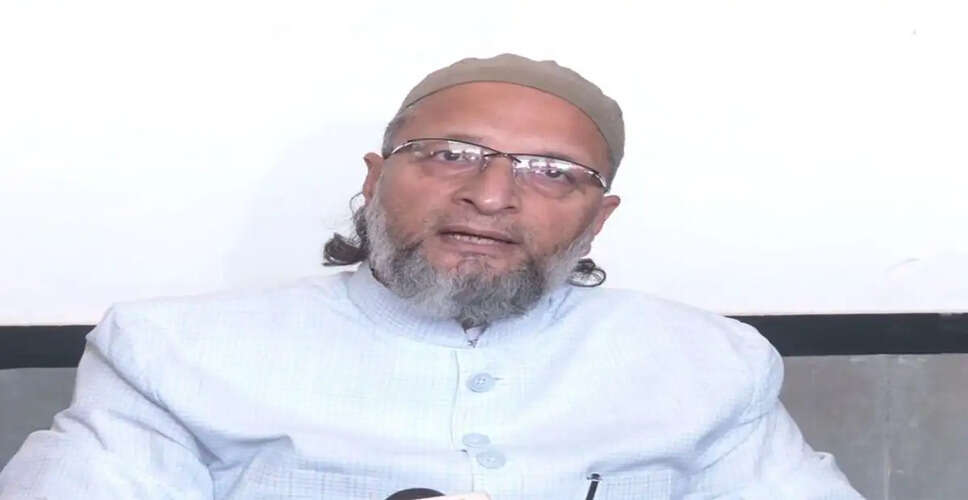

Concerns Raised Over Voter Identification Requirements
Asaduddin Owaisi, the leader of AIMIM, has expressed his concerns regarding the Election Commission's (EC) ongoing 'Special Intensive Revision' (SIR) process in Telangana. He criticized the current voter identification verification requirements as excessively burdensome, arguing that they effectively exclude many individuals from participating in the process. During a press conference, the Hyderabad MP highlighted the significant challenges faced by citizens whose names are absent from the 2002 voter list.
Unrealistic Documentation Requirements
Owaisi pointed out that the EC's stipulation to submit one of twelve specified documents is impractical. He noted that four of these documents are either nonexistent or irrelevant according to the state's administrative framework.
Inapplicable Documents in Telangana
Among the documents listed is the National Register of Citizens (NRC), which has never been implemented in Telangana. Additionally, documents such as the Permanent Residency Certificate and Family Register System are not issued in the state.
Request for Reduced Documentation
Owaisi stated that they have requested the EC to lessen the documentation burden for voters whose names are not on the 2002 list, nor are their parents or grandparents listed. He emphasized that the NRC is not a viable option in Telangana, and the Permanent Residency Certificate is also unavailable. Furthermore, the Family Register System does not exist in the state, and the Aadhaar card is not recognized as a valid document. These comments come as the SIR process begins in Telangana, with Booth Level Officers (BLOs) distributing enumeration forms door-to-door. The draft voter list is set to be published on July 31, with a period for claims and objections from July 31 to August 30, and the final voter list will be released on October 1.
Criticism of Voter List Errors
Despite the widespread use of Aadhaar for identification, Owaisi argued that the EC refuses to accept it as the sole valid document. He suggested that the commission should consider accepting PAN cards, as they are as reliable as other state-issued documents like driving licenses and food security cards. Owaisi further noted that out of the twelve required documents, four are essentially unavailable, leaving only eight. He reiterated the request for the EC to accept PAN cards, as individuals can vote based on state-issued documents like driving licenses or food security cards. However, the EC has not accepted this suggestion.
Questioning the EC's Standards
Owaisi highlighted several 'flaws' in the 2002 voter list, which was manually compiled by the EC. He questioned the commission's criteria regarding familial relationships. He criticized the EC for penalizing current voters for errors in the manually prepared 2002 list, such as spelling mistakes or arbitrary age gaps between generations. He asked how voters can be punished today for the EC's mistakes in that list. He also questioned the legality of excluding names from families with six children and the age gaps allowed between parents and children or grandparents and grandchildren. Owaisi reiterated his demand for the EC to share pre-SIR mapping data with Booth Level Agents (BLA) to ensure that the revision process is inclusive and transparent, claiming that this request has been repeatedly ignored.