
Owaisi Criticizes Union Minister for Comments on Muslim Minority Status
In a recent political clash, Asaduddin Owaisi has sharply criticized Union Minister Kiren Rijiju for his comments regarding the Muslim minority status in India. Owaisi accused Rijiju of systematically denying the fundamental rights of Muslims, particularly in light of his controversial comparison of the Muslim population to that of the Parsi community. This incident has sparked a broader debate about minority rights and demographic classifications in India. Owaisi's arguments highlight the complexities of minority status under the Indian Constitution, raising questions about the implications of such classifications in a diverse society. The ongoing discourse reflects the tensions surrounding minority rights in the current political landscape.
| May 20, 2026, 12:46 IST
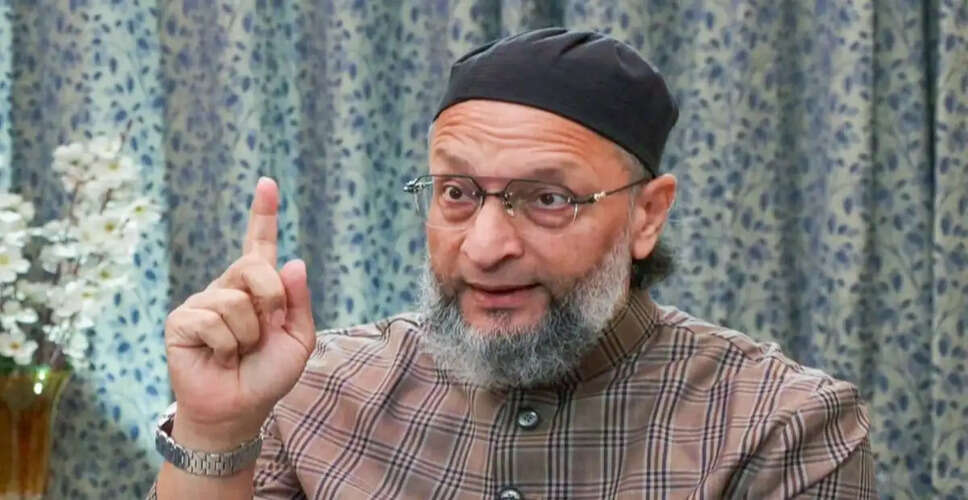

Owaisi's Strong Rebuttal to Kiren Rijiju
The leader of the All India Majlis-e-Ittehadul Muslimeen (AIMIM), Asaduddin Owaisi, launched a fierce attack on Union Minister for Minority Affairs Kiren Rijiju on Wednesday. Owaisi accused Rijiju of systematically undermining the fundamental rights of India's Muslim population. This controversy arose from Rijiju's remarks comparing the minority status of Muslims to that of the Parsi community, stating that the Muslim population in India is so large it could be the sixth-largest country in the world, while the Parsis number only around 53,000.
Read More: Owaisi Reacts to Bhojshala Verdict, Calls it 'Second Babri', Supreme Court Battle Ahead
Responding sharply on the social media platform X, Owaisi labeled Rijiju as an anti-minority minister and questioned his understanding of demographic classifications. He argued that under Article 30 of the Indian Constitution, which grants minorities the right to establish and administer educational institutions, any non-Hindu group in a Hindu-majority nation is legally considered a minority.
Owaisi posed a simple mathematical question to Rijiju: which is larger, 79.8% or 14%? He emphasized that if Hindus are the majority, then every non-Hindu group qualifies as a minority. He accused the minister of spreading misinformation to deprive Muslims of their fundamental rights. To challenge the minister's argument, Owaisi cited regional linguistics, stating that if a group cannot be classified as a minority based solely on population, then Hindi speakers in non-Hindi speaking states should not be considered a linguistic minority, even if their numbers exceed the combined populations of the United States and Canada.
This confrontation follows a press conference held by Owaisi earlier this month in Chhatrapati Sambhajinagar, Maharashtra, where he expressed serious concerns regarding the verification of local voter lists.
Read More: Owaisi on Dhar Bhojshala Case: Muslim Side to Approach Supreme Court
Owaisi alleged that a "systematic agenda" driven by hate is targeting the Muslim community by linking the Special Intensive Revision (SIR) of voter lists with controversial citizenship frameworks like the National Register of Citizens (NRC) and the National Population Register (NPR). During a press conference in Chhatrapati Sambhajinagar, he stated that the Supreme Court has mandated mapping and claimed that if mapping is not conducted, it will be done based on parents' names. He further alleged that this application operates through location tracking and claimed that during the verification of 2.7 million names, 97% were Muslims.
Stay updated with the latest political events and major news across the country by reading National News in Hindi.